Showing posts with label founder. Show all posts

Monday, June 12, 2017

LND: Horses. (Part I)


   This may seem strange, coming from the LATOC's Old Horseman, but horses may not figure into many preppers' plans.

   Our grandfathers switched from horses and mules to trucks and tractors for good reason.  Horses require considerable knowledge and skill not only to work well, but just to keep sound and healthy.  Unlike infernal combustion machines, which can be put into the garage and ignored, equines have to be fed and cared for three-hundred and sixty-five days per year, whether you're using them or not.  They need pastures and paddocks with well-maintained fences.  Properly constructed stables.  Hay, feed, hoofcare.  Etc., etc., etc...

   Fuel, replacement parts, and other things needed to keep tractors and automobiles going may someday become inaccessible, making horses the best solution for rural transportation and farm traction again.  But, if all you really need is a light motorcycle for errands, and a rototiller for the kitchen garden, you might be able to scrounge up a few gallons of gasoline and motor oil to keep them going for years to come, even in the face of shortages or rationing.

   On the other hand, if you need to transport people and cargo beyond what you can move with a cycle, or your doomstead operations require substantial pulling power, equines might make sense.  Riding horses are excellent for long-range reconnaissance, being quieter than motorcycles, better off-road than wheeled vehicles, and having a built-in GPS system.  (Horses are great at finding their way back to the feed trough, no matter how lost their riders get.)

   Whether you have a pressing, practical need for them or not, the opportunity to keep horses may be considered one of the benefits of doomsteading.  If you're living out in the boonies anyway, may as well take full advantage and experience the joys of horsemanship, if you are so-inclined.

   If you are one of the few 'steads in a 'neighborhood' with solid workhorses and equipment, you could find yourself in a position to provide valuable services to your community should the petroleum-fed equipment be silenced.  Hobbies sometime become lucrative occupations.

   Horses do require a substantial investment in treasure and/ or personal effort.  The more equestrian knowledge and skill you have, the less coin you'll need to spend.  Many books have been written on husbandry, training, horsemanship, and farriery.  (Some by myself.)  So I'll try to keep it to an overview here...


Speaking the language...

    An intact male, adult (usually over four years old) horse is a stallion.  A juvenile male is a colt.  Stallions are sometimes called studs, especially if they are used for breeding.  Some folks, especially our cousins across the Big Pond, call a breeding farm or program a stud (shortened from stud farm or stud book).

   A castrated male horse is a gelding.  Most colts are gelded, as geldings are generally the preferred gender for riding and work horses.

   An adult female (usually over four years old) horse is a mare.  A juvenile female is a filly.  Mares are very rarely spayed, as the surgery is far more expensive and risky than gelding colts or spaying smaller animals.

   Very young horses of both genders are foals.  Pregnant mares are said to be in foal.  The birth process is called foaling.

   Horse height is usually measured in hands (four inch units) followed by remaining inches.  "15-3" means the horse is fifteen hands and three inches (63" total).  This measurement is made at the withers, the bony protrusion where the top of the neck meets the horse's back.  

   A pony is a small horse.  Usually less than 14-2 hands, though breed and show organization standards vary.  A pony under 9-2 hands may be called a miniature horse.  Ponies and miniature horses are the same species as full-size horses.

   The donkey, also known as an ass or burro (especially smaller specimens), is a separate species in the same genus as the horse.  Donkeys tend to be smaller, slower, less athletic, smarter, surer of foot, more fuel-efficient, and tougher than horses.  The go-to beasts of burden in the Third World, they can be prone to some maladies due to easy living here in Cornucopia.  (Like founder from overeating.)

   A male donkey is a jack.  A female is a jenny.  Large donkeys are called "mammoth jacks" (over 14-2) and "mammoth jennies" (over 14 hands).  The largest are up to 17 hands.

   A mule is the result of a mare being bred to a jack.  Being a hybrid of two distinct species, they are almost always born sterile.  A male is a john, and is normally gelded, since he has no reproductive potential, and all the behavioral challenges of a stallion if left intact.  A female is a molly.  In extremely rare cases, mollies have been fertile, but it's a literal one-in-a-million fluke.

   A hinny is the result of a jenny being bred to a stallion.  Generally smaller and less strong than mules, and harder to successfully produce due to the genetic technicalities of having the female parent with the lower chromosome count, hinnies are somewhat rare.


Horse types....

   There are countless breeds and types of horses on the market today, each with their ardent fans.  Since the focus of this book is doomsteading, I'll be omitting horses bred for show, novelty gaits, and racing.  We're looking for animals who can get enough useful work done to justify their upkeep around a self-supporting farm. 


Quarter Horse.

   The American Quarter Horse got its name for being bred for the equestrian version of drag racing; quarter-mile races from a standing start.  Their explosive acceleration and agility made the breed dominant in cutting, reining, rodeo, gymkhana, and similar competitions.  Handsome in form, calmly alert in disposition, muscular but compact in size, the Quarter Horse became the default ranch horse...  But the primary breed registry, the American Quarter Horse Association has a long history of tossing the breed standard out the window in favor of generating revenue for the organization, so there are horses of such broadly ranging types with AQHA papers now that registration is virtually meaningless.  There is little wonder that, in recent years, "quarter horse" has come to denote any generic riding horse between pony and draft size, including paints and appaloosas.

   Quarter horses are your basic American riding stock.  It's easy to find tack, equipment, and everything else to fit them.  Most are pretty durable and easy keepers.  And they can do a very wide assortment of things well in terms of riding styles and activities.

   Quarter horses can be trained to harness, and many do quite well.  But sudden acceleration and turn-on-a-dime agility are definitely not desirable between cart shafts or in a plow row, and the 'rear wheel drive' conformation of the quarter horse is not ideal for pulling.


Morgan.

   The old-school Morgan is like the quarter horse's even more blue-collar cousin.  Not quite as athletic, but strong, compact, rugged, and utilitarian.  Unfortunately, Saddlebreds (among the least practically useful horses for real work) have been a corrupting influence on the Morgan breed in recent decades, making the classic type Morgan harder to find.

   Traditional Morgans are the quintessential, jack-of-all-trades farmstead horses.  Being a little heavier on the forehand, they generally fall just shy of quarter horses for riding applications, but tend to be superior for harness work.  Their compact size makes them easier to manage and fit with tack than draft horses.


Drafts.

   Draft horses are the giants of the horse world.  Commonly a foot taller and a half-ton heavier than the typical quarter horse.  And they're even stronger than they look.  Because the draft breeds were developed with matching hitch teams in-mind, they tend to be very uniform in appearance.  (American Belgians are usually red with blonde manes, blaze faces.  Percherons are usually either black or grey with stars and minimal white leg markings.  Clydesdales and Shires usually have dark body coats with lots of white on the faces and limbs, long 'feather' hair on the legs.) 

   Draft horses are bred to pull heavy stuff.  If one gigantic superhorse isn't enough to move something, they like to work in teams.  Draft horses are usually calm, even stoic. (But don't buy into the 'Gentle Giant' thing too much. They can spook like any horse.  Some know their own strength and get pushy.)  Most are fairly fuel efficient, needing no more feed than quarter horses, and only a bit more hay.  When it comes to pulling deep plows through tough ground, big combines, or freight wagons, draft horses rule.

   Draft horses can be ridden, and doing so has become quite popular lately.  But, honestly, they aren't very good for it.  They're slow, lumbering, and lack endurance.  Their height makes them difficult to mount.  Their size can be problematic all-around.  The horse world is geared for quarter horses.  Harness and tack for full-size draft horses often has to be special ordered.  They may not fit into horse trailers for transport.  They require double-doses of dewormers.  Draft shoeing is widely considered a specialty, and farriers competent to do it properly may be expensive and hard to find .

   In the Deep South, the square-cube law, which dictates that bigger horses have less skin surface per pound of body weight, hits draft horses hard.  (Darn you, Galileo!)  They have considerable trouble coping with the heat and humidity of the Dixie Summer.  In my own experience, top-quality bred drafters have had a distinct inability to bounce-back from infections the gigantic Petri dish that is the southern environment can throw at them.  Perhaps due to inbreeding.  They don't seem to get sick more often than other horses, but they tend to die (despite massive veterinary intervention) when a quarter horse would have recovered.


Haflinger.

   Once upon a time, some Belgian draft horses got so dirty that their people washed them with REALLY hot water, and they shrank somethin' fierce! 

   Okay.  The Haflinger is an old and storied European breed.  But they do look rather like one-third scale Belgians.  Usually large pony to small quarter horse height, around fourteen hands.

   With their modest size, strong build, and tractable nature, Haflingers could fill a farmstead role similar to the classic Morgan.  They are about the least intimidating mounts for inexperienced riders due to their modest stature, sunny look, and friendly disposition. 

   While they are strong enough to carry men, their size does make them more suitable for kids and ladies when it comes to working under saddle. 


Standardbred.

   The Standardbred was developed for harness track racing at the trot or pace.  Those that retire from or don't make it to racing careers are often picked-up by the Amish and other folks looking for good light driving horses.  They are similar in height to quarter horses, but a bit lankier.  Bred for function, they do tend to be a bit plain in form and coloring.  But that may be considered a plus from a doomsteading point of view.  They are generally less high-strung than their Thoroughbred cousins.

   When it comes to driving the buggy or buckboard into town, the Standardbred will get you there faster and easier than any other.  They are bred to trot or pace long distances, and most get basic driving training at an early age.  They are the size of an ordinary riding horse, and many serve well under saddle as well.

   Standardbreds are a bit light for heavy pulling and farm work.  (Cultivators, hay rakes, and the like should not be a problem for them.)  Under saddle, it may take some work to perfect a smooth transition to the canter, as Standardbreds are trained never to canter on the track.  Some Standardbreds are bred and trained to pace rather than trot.  This is fine for driving, but the pace is not a desirable gait under saddle.  Most can be trained out of it.


Draft Cross.

   "Draft cross" covers an awful lot of territory these days.  The ups and downs of the Premarin market have flooded America with assorted draft and part-draft mares and their offspring.  Essentially, big mares whose previous greatest value was the ability to make copious amounts of urine, and the results of them being bred to whatever stud was handy.  Not exactly a recipe for consistent quality.

   On the other hand, some breeders have crossed carefully selected light and draft horses to achieve an intermediate type, physically similar to European Warmbloods.  Our own program bred full-sized, fancy hitch type, pedigreed Belgian and Percheron mares to extremely sound and athletic American Quarter Horse stallions. 

   The better draft cross horses are bigger and stronger than quarter horses, but have better speed, grace, endurance, and hot climate resiliency than full drafters.  The have the mass for fairly heavy pulling and farm work, but don't need to stop and blow too often when pulling the buggy down the road, even at a near Standardbred rate.  They fit well under a big man's saddle, yet you don't quite need a ladder to get onto them.

   While some 'rescue' part-draft horses are surprisingly good specimens, many more are about what you'd expect from such programs, or from breeding Premarin cast-off mares to Billy-Bob's backyard spotted rackin' hoss stud.  Big, intimidating horses originating from situations where training isn't a priority, 'rescued' by well-meaning but not horse-wise people, can be a menace. 

   Most draft cross horses can use large or warmblood sized tack and trailers, and can be serviced by general practice farriers.  But some of the larger ones may require draft specialty equipment and services.


Mules.

   Mules come in all sizes, from miniature to draft.  Their application is generally the same as the corresponding type of horse.  But they tend to be stronger for their size, surer of foot, more durable, and able to stay in good condition on less feed and hay.

   Since mules don't reproduce themselves, quality specimens of working size can be hard to find and sometimes expensive.  Mules also tend to be noticeably more intelligent than the average horse, which may not always be a good thing.   Pretty much all equines can physically overpower their human masters.  We don't need them outsmarting us as well!


Pony.

   Most ponies today are the outgrown and forgotten playthings of children, who are lucky to find a place as pasture mascot or back yard pseudo-dog somewhere.  But that doesn't mean they can't be useful on a doomstead.

   Ponies tend to be proportionately stronger than horses, as well as tougher and more fuel-efficient.  Their small size makes them suitable mounts for children, less overwhelming for inexperienced handlers, and more maneuverable when working in tight spaces, like short crop rows.  Harness and carts are widely available in pony size, and the little guys can pull a considerable load.  Ponies seem to have an extended life expectancy, though this is hard to pin-down since many have been hanging-around in the background so long that nobody remembers exactly how old they are.  Reasonably healthy, young ponies are often very inexpensive, though training is usually required.

   Ponies have a reputation for bad attitude, though this may be due to being handled by ornery children, then abandoned and neglected.  Short legs don't make for speed or grace.  Size does matter, so they are limited when it comes to how much they can carry or pull.  They can be 'easy keepers' to a fault, becoming obese on just grass in some cases.  Founder is a very common problem with ponies.


------------------------------------ End Part One -------------------------------------

   Looks like this will be a long chapter.  So I'll put up the rough draft in parts.


- - -


.

.


Thursday, November 26, 2015

'Tis the Season...


   Well, the Thanksgiving Feast is done.  Hope this season found y'all well and in good company!


   Now it's for those turkey sandwiches, midnight pumpkin pie raids, and (of course) the start of the holiday shopping season!

   For those of you with tech-inclined horse-folks on your shopping list, Millwater's FARRIERY, the encyclopedic reference of hoofcare and horseshoeing, is now available in Kindle Edition for less than half the trade paperback price.  This ebook version includes all the content of the print edition, and has hyperlinks for cross-referencing with a tap or click!


   For the Christmas season, I'm activating Amazon's "Matchbook" feature that allows folks who buy the paperback to add the Kindle Edition for $2.99.

   For Black Friday / Cyber Monday you can also get the trade paperback version of Millwater's FARRIERY for one-third off the list price by ordering direct and using code ZT7855DA .  This code only works for direct order, not on Amazon.

   Of course, Amazon will be running various promotions of their own.

   You can follow Millwater Publishing on FaceBook and Twitter for the various discount sales of the Hardcover Edition and eBay promo copies.


- 30 -

. . . 

.

Friday, November 28, 2014

Millwater's FARRIERY: 20 Years of the Farrier's Dictionary...

.

   Hope you all had a great Thanksgiving, and are progressing into a merry Christmas Season!

   2014 marks the 20th anniversary of Millwater Publishing's dictionary of farriery publications. It started with just a humble, saddle-stitched glossary with pen and ink diagrams and daisy-wheel generated master copies...


   Since then, there have been many updates, expansions, and upgrades in production.  Now it's a perfect-bound trade paperback or glossy hardcover with photographic illustrations. The content has evolved into more encyclopedic form, with extended articles and lots of cross-referencing for efficiency.  Covering ground from basic horsemanship to advanced farriery, with a focus on practical application. 

   It makes me a little embarrassed to look back at some of the early editions.  But they do serve as interesting markers to the eras in which each edition was published.


   The current edition is designed to be a handy reference for horseowners, students, farriers, and other equestrian professionals.  


   I usually post promotional discount codes for the hardcover version on the Millwater Publishing FaceBook Page and Twitter feed.  (I don't make those up.  I just report 'em!)  

   Right now, Amazon is doing 30% off the trade paperback if you use checkout code HOLIDAY30

   And, to celebrate 20 years of the lexicon project, I'm going to do them one better for Black Friday through Cyber Monday with 50% off the trade paperback when you ORDER DIRECT and use check-out code RXYKQG6P


.

---

-30-


Friday, November 29, 2013

Millwater Publishing: 'Tis the Season...


   Hope you all had a fine Thanksgiving!  Now that it's Black Friday, let's see what kind of holiday specials we've got going on...

   You can order Millwater's FARRIERY trade paperback directly at this link, and enter the code: YPLFZ3CT for a 25% discount.

   Amazon has the trade paperback at 10% off.  Even lower through some of their independent resellers.

   Promotional copies of both the trade paperback and deluxe hardcover are usually available on eBay at a great deal.


- 30 -

.

. . .


Saturday, February 23, 2013

Millwater's Farriery: Barefoot Movement Revisited...

.

   Scuttlebutt over on the Facebook is that a horse magazine article has the whole Barefoot Horse cult back in the spotlight.  Of course, we'be been around this track a whole lot of laps over the years, so I'll just give us a quick round-up...


On this very blog-

A refutation of the BAU-definition of the "traditional farrier trim" and the whole notion that the "barefoot experts" can accomplish some magic via horn removal that farriers are somehow to ignorant to comprehend.

How all the claims of special trimming techniques (complete with endless diagrams and critiqued photos online) on horses left barefoot are inherently silly given the fundamental limitations of unshod hooves.

Horseshoe Alternatives, and the ridiculous lengths the BAU will go to avoid conceding the value of conventional farriery.


On Doug Butler's blog-

Leading farrier educator, internationally credentialled author of the foremost textbook of farriery (Principles of Horseshoeing 1974, expanded editions 1985 & 2004) gives his take on the whole barefoot movement.


On Click & Trim-

Barefoot horse enthusiasts concede some of veteran farrier Rick Burten's points with good humor.


Moldy Oldies-

My go-arounds with the Barefoot Movement from over a decade ago.


- 30 -
.


Friday, December 14, 2012

Millwater's Farriery: Project Lexicon...


Project Lexicon... About Millwater's Farriery.
"The beginning of wisdom is the definition of terms."
-Socrates.

   Many years ago, when I was stumbling up the path from being a 'guy who shoes horses' to becoming an actual farrier, I started taking the trade journals, attending clinics, and doing the best I could to expand my understanding of art and science. Problem was that writers and speakers often threw around references and expressions, assuming that everyone was already familiar with them. ...Some of us weren't!

   I wire-brushed the devil out of the bottoms of a lot of hooves trying to get them clean enough so that I could see the "dot" that Duckett fellow had discovered, which some magazines mentioned, but didn't explain.

   Then there were the articles and lectures from veterinarians and academic researchers. They like to use a lot of ten dollar words just to show-off. But, when you think about shoeing horses, even simple terms like "up", "down", "right", "left", "front", and "back" can be confusing due to the fact that we look at things from so many different points of view. Sometimes the fancy terminology really was more precise.

   Even 'plain old' horseshoeing language caused confusion. I recall an early contest where there was a rather heated argument between the judge and a contestant over "heel calks", "corks", and "blocked heels"... Then there was a clinic where I found myself exchanging confused shrugs with a few other tarheel farriers as the lecturer explained that "Over eighty percent of the pleasure horses in the show ring speedy-cut at the passing gait."

   By the early 1990s, it had gradually dawned on me that there ought to be a glossary of farriery.   I'd successfully written for several major equestrian magazines by then, so I decided to give it a go.   In 1994 I published The Pocket Dictionary of Farrier Terms and Technical Language.  It sold-out pretty quickly, even as better authoring tools became available to me, and a lot of new terms that needed to be included became apparent.  So, the following year, The New Dictionary of Farrier Terms and Technical Language was published.

   There wound-up being eight editions of the New Dictionary between 1995 and 2010.   Each featuring new terms, refined and expanded definitions, more and better illustrations.

   Initially, the focus was on the sort of scientific and specialized jargon you can't look-up in Webster's.  But, over the years, I realized that there were a lot of horseshoers with impressive technical knowledge and skills who had somehow managed to skip over some fundamental basics.   I also discovered that many of my readers were other equestrian professionals and horseowners.   So I began expanding the scope of the Dictionary to include the "foundation" terms needed to support the advanced material.

   Terms evolved into topics.   Definitions into articles.   With the tenth print version of the lexicon, it has grown into something new.  An encyclopedic dictionary.  A cross-referenced collection of interlocking entries designed to allow readers to come in at any level from prospective student or interested horseowner to established professional, and go up, down, or sideways as their reference needs dictate.

   It was on the advice of two veterans of farrier publishing that I added my name to the title of the tenth lexicon.  I was a little reluctant.  Even my hubris has limits...   But it ultimately made sense.  The transition to an encyclopedic format, centered on articles rather than mere definitions, meant that the book would reflect my own experience and approaches more than the previous works had.  This will probably elicit some criticism, as I do tend to develop some unusual techniques...

   As I was finishing-up with shoeing a rather tricky therapeutic case, I mentioned to my wife that I was going to have to work on finding a way to explain a "trick" I'd used for an article.

   She said "You can't tell other people how to do that!"

   "Why not? You know it works."

   "Yes," she allowed. "But nobody but you can make it work right."

   I'm pretty sure she's mistaken on that point. But she made me put-in a disclaimer anyway.


...

- 30 -

.


Wednesday, November 28, 2012

Millwater's Farriery: Discounts...


   'Tis the season...  Wood stove cracklin' Nat King Cole and Bing Crosby on the radio, and Christmas Season discount time for Millwater's FARRIERY: The Illustrated Dictionary of Horseshoeing and Hoofcare...


AMAZON has the trade paperback version at 15% off, free super-saver shipping also applies!

Or you can order direct and get a 25% discount by entering code "YPLFZ3CT" during check-out.


- 30 -

.


Friday, November 16, 2012

MILLWATER'S FARRIERY: 2012 Wrapping-Up...


   Hard to believe the holidays are almost upon us again.  Impending Mayan Apocalypse Doom notwithstanding, it's been a pretty good year.  Our home dairy project has worked-out, and the raw milk has me healthier than I've been in many years.   We're getting ready for the big draft horse sale.  (Always more exciting when you're actually looking to buy one.)  And MILLWATER'S FARRIERY has done nicely in it's first year.

Not the first year for the Dictionary in general, of course.
Just for the new, encyclopedic version.

      It's kinda' funny in this era of modern distribution to see royalties coming in Euros and Pounds instead of just plain old Dollars.  I reckon it really is a global economy now.  

   I'd like to thank all the readers on both sides of the Big Pond who've made the book a success.  I hope you have found it useful.

   I'll be posting the discount codes for the holiday sales here and on FaceBook as they become available.  But those of you who want the hardcover version can get a deal on the promotional copies that are usually available on eBay.  Even the holiday e-coupons probably won't match the price there.  Come to think of it, the trade paperback is also there at a discount...  

   For those of you who like to stick with Amazon, they have the paperback at a 10% discount right now as well.  (I have no idea how long it'll stay that way.)

   Finally, although I've been seriously distracted and busy in meatspace lately, if anyone out there has a farriery topic they'd like to have addressed or revisited on this blog, just let me know!


. . .

- 30 -


Monday, June 18, 2012

Millwater's Farriery: Down and Dirty Bar Shoes to Git-er-Done!


    The first thing a horseshoer in this day and age might ask is  "Why would I even want to fabricate bar shoes when there are godzillion prefab bar shoes to choose from?"

   Well, it wasn't that long ago that we didn't have such a great selection.  And, the way things have been going lately, you never know how many of your favorite shoe manufacturers might go the way of the dodo, or at least be driven to streamline their offerings in times to come.

   But, even while there are prefab bar shoes available, there are some advantages to making your own.  One is simple inventory.  If you keep a supply of several different bar shoes in five or six sizes each, it adds up to a load of shoes pretty quick.  More stuff to haul around in your rig or to eat up space in your shop.

   Another advantage to making your own bar shoes is nailing.  Most horseshoers have a favorite keg shoe they use more of than anything else, and nailing this shoe becomes fast and accurate second nature.  Switching to another make of shoe, especially on a horse who may be sore (which is why he needs the bar shoes, right?) will make precise shoe placement and expedient application that much harder on the squirming, unhappy critter.  If the bar shoe were based on your favorite keg shoe, it'd be easier.

   Fitting prefabricated bar shoes can also be somewhat difficult, especially with heartbars, which are hardest to shape well with the tongue plate in the way, and tend to be needed in cases where a precise fit is even more essential than usual.

   Like a lot of horseshoers, I first started making bar shoes by selecting a keg shoe a couple sizes larger than the horse would normally wear, then turning the heels in to forge-weld them together.  This approach had some serious shortcomings.  Keg shoe stock gets thicker and wider as sizes go up, so the resulting bar shoes would be excessively heavy.  The nail holes would also be shifted too far back, and set too coarse.  And, if the horse already took the biggest size of keg shoe in the box, there were no bigger ones to make bar shoes out of.

   For a number of years, I got into the habit of forging all of my bar shoes from bar-stock.  This was quite an improvement over using an over-sized keg shoe.  But it could be a bit of work, especially in the busy season.

   One Summer evening, while I was catching up on some forge work in the shop, the wife came out and said we'd had a call from a customer whose mare was in eggbars, one of which had been lost out in the pasture, and needed us to swing-by and fix her up a few days ahead of schedule.  Knowing we'd be pushed for time the next day, and being ready to come in from the shop that evening, I decided to try a short-cut.  I grabbed two pair of my favorite keg shoes (St. Croix Rim Lites), used my V-hardie to cut off one pair right behind the toe-nails, and riveted the cut-out toes across the heels of the whole shoes to form the "O" shape.  One welding heat to just lightly tap the first joint together without buggering-up the other side.  Second welding heat to fully weld and shape the other side. A third heat to finish-up the first side.  In no time, I had a pair of eggbars ready to go.


   When I applied them, I discovered that these eggbars were easier to make final cold-fitting adjustments on than my handmades, and were all-around quicker and easier to get on the horse.  And, once the horse had polished them up a few days, the horseowner thought they were prettier than my hand-forged irons.  (Kinda' hut my feelings, that!)


   It wasn't a great leap to figure out that, by inserting the cut-out toe across the heels of the whole shoe, but facing the other way, I could whip-up straightbars just as easily for performance horses who needed a bit of extra support and stability, but would likely step-off eggbars.

(Worn shoe.)

   Of course, this left me with a bunch of partial shoe branches lying around.  Then it occurred to me that, if I crossed 'em, welded them together, hooked out the "heels" a bit, and punched rivet holes, these would make great frog plates for heartbars.  This is particularly handy, as horses in need of heartbars are often in no shape to stand around having their feet messed with for very long.  This way, I can just cold-fit a pair of keg shoes in a jiffy and let the horse go rest while I forge-weld in the pre-made frog plates.  When we go back to the horse, all I have to do is fine-tune the plate pressure and nail-on.


   They may not be as impressive as contest-winning handmades, but the horse is just going to grind the things into the mud and manure anyway.  When it comes to getting the job done, these humble bar shoes are as good as any.


- 30 -

...


Monday, April 16, 2012

Livin la Vida Amish...


   As with the old Chinese curse, we are living in interesting times.

   Between rising prices, and the proliferation of grossly unhealthy additives, substitutions, and GMO Frankenfoods in grocery store "food" products, a lot of folks are looking towards some level of self-sufficiency.


   Fuel and equipment upkeep costs are motivating some small farmers to revisit really old-school approaches...


   Our latest distraction here has been getting old-fashioned production of real, unadulterated milk flowing.  (Once you discover fresh, creamy, raw milk from a grass-fed Jersey, you'll want to punch the grocer right in the nose for passing-off that bleached and boiled, watered-down sewage in plastic jugs...)

Around here, THIS is a milk "by-product".

   Draft horses seem to be gaining in popularity in recent years.  This may have started-out with folks wanting to breed them to performance stock to develop American sport horses.  But more and more, folks appear to be gaining an appreciation of draft horses for what they are...  Which means even veteran horsemen have to learn a whole new world of things, like collar fitting, harness types, and so forth.  And, of course, farriers have to become conversant in these new things as well.  Farriers have always been expected to know a good bit more about horses than how to mount them on iron.


   This is why some fundamental draft horse and harness information worked its way into Millwater's Farriery: The Illustrated Dictionary of Horseshoeing and Hoofcare.  The big critters are part of the scene on our farm too, and doing what they were bred for.


- 30 -

.

Monday, April 2, 2012

Millwater's Farriery: In Review...


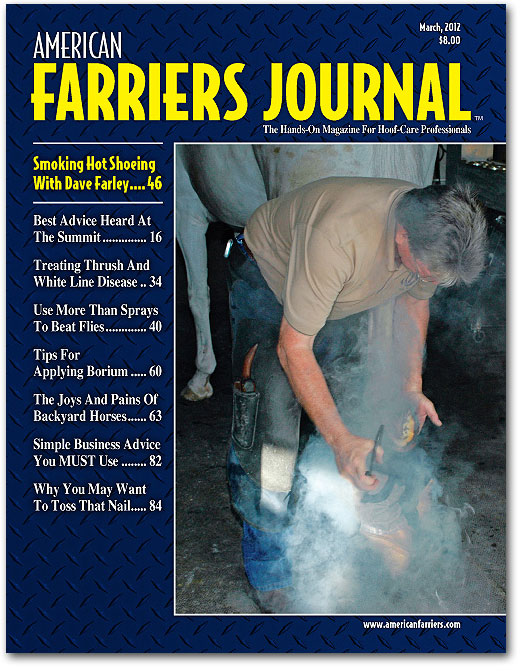
   Bob Smith of Pacific Coast Horseshoeing School was kind enough to review Millwater's Farriery: The Illustrated Dictionary of Horseshoeing and Hoofcare for the recent issue of the American Farriers Journal.


   The blurb from the review is "An excellent reference for shoers, owners and farrier students..."

   He also observed that the dictionary had evolved into a "mini-textbook" of farriery.  Something I realized myself as I was putting it together. 

   This actually gave me pause at the time...  After all, we are blessed with some really great, full-on farrier textbooks in this day and age.  It was certainly beyond the intended scope of the lexicon project to 'compete' with them.

   But the massive textbooks from Butler and Gregory are designed for dedicated students going through training at the better farrier schools on the way to careers as professional farriers, and retail for several times the list price of my book...  I know a lot of people interested in farriery aren't starting-out at that level.  Especially in times like these, I figured there was a place for an entry-level primer rooted in the fundamentals.  Something to get the prospective hoofcare provider (or horseowner who has to resort to doing their own) started so they can find out if it's really for them, then they can move-on to the more advanced training and texts appropriate to their chosen career paths.

   Smith did bust my chops on the "selected resources" appendix of the book...  And not without justification.

   I included Crudoir on the "periodicals" page.  At the time the review was written, all there was of the magazine was a webpage announcing the upcoming launch...  Since then, that has been replaced with an announcement that they've given-up on the plan for a new magazine as-such, and are going "another direction".

   Well, that's the peril of reference book publication.  Even in this modern age of fast publishing tech (and believe me, it's like greased lightning compared to the 'good old days'), I still had to put the content to bed and shift to formatting and set-up long before the actual release.  I'd been in-touch with the intended publisher of Crudoir, and she was in-earnest about making the magazine a reality...  I didn't have the option of waiting to see if it caught-on, so I included it.  Actually, I figured that even if it didn't fly, it'd be an interesting footnote in the future.  Henry Heymering's bibliographic history tome On The Horse's Foot cites a number of publications that are only known due to their being mentioned in old reference books.

   Then there was the fact that, with the folding of so many other farrier periodicals, the American Farrier's Journal is effectively the Last Man Standing.  Frankly, I had to stretch a little bit just to keep AFJ from being completely alone on the page! 

   As to the weakness of the "Internet resources" page, he's got a point there.  In truth, that section is almost vestigial.  Left-over from earlier dictionaries before Google was built right into all our browsers, when you actually needed to know a URL to get to a resource.

   I certainly didn't intend to snub the AFJ website in this section.  Since a URL was included on the "periodicals" section, where AFJ was at the top of a far less crowded page, I figured putting it in the "Internet" section was kind of redundant. 

   With the ever shifting sands of the Internet, I'm also a little reluctant to reference new Internet documents, as they have a nasty tendency to get moved or gone as websites get 'updated' and redesigned.  My personal favorites/bookmarks lists attest to this with tons of now '404' links.


   On a side-note, I included contact information with the Press Release which was really intended in-case the folks at AFJ needed to touch base with me.  (Sort of traditional PR format.)  Unfortunately, I apparently didn't make that clear, as my farm land line and snail mail address got published with the review...  I rarely use the land-line, and can barely hear incoming messages due to interference from the electric fences...  And all orders are ultimately processed over the Internet anyway.  (I do not have a warehouse of books and mail packaging like the not-so-good old days.)

   If someone really hates to order over the Internet, they can ask at a brick and mortar book store.  They're not likely to have Millwater's Farriery in stock (as it's a specialty kind of book), but it is available through regular distribution channels, so they can order it.


- 30 -

.


Monday, March 19, 2012

Millwater's Farriery: Founder Frustrations...


    A recent posting over on the American Farriers Journal refers to "Hitting the Wall With Chronic Laminitis"...

   I can dig it.  Just worked on one I've been doing for many years.  They can be quite frustrating.

   The problem is that the malady isn't really in the hooves.  Heck, I can fix the hooves.  And have fixed them time and again.  Pushed the bone column back up off the ground.  Built-up a solid, thick sole.  Got the dorsal surface of the wall parallel to the front of the coffin bone.  Better feet by all measurements than many 'sound' horses are wearing...  Back to regular shoes or barefoot, and all is well for a while.

   Then "kersplat!"...  Sole goes flat.  Abscesses all over.  Hoof capsule warping all out of shape... 

   So I fix him again.  And again...  In time it becomes apparent that he's still stilt-legged, even when his feet are in good shape.  And he's starting to look like a skinny wooly mammoth in the Summertime.

   There's the rub.  The source of the problem is ultimately in the endocrine system, and the flexor muscles and tendons.  Put perfect feet on the legs of a horse whose flexor muscles are drawing up into balls, and with a pituitary sending out haywire signals to have the horse essentially poison himself, and the feet won't stay perfect long.

But people get a little upset if you try to take the nippers to these bits.

   Brain surgery to get rid of a pituitary tumor isn't really plausible with most horses.  Various drug, supplement, diets, and hormone treatments are tried, but they only work 'sometimes', as the nature of the condition is constantly changing.

   Deep flexor tenotomy can help... But vets are often reluctant to try it.

   So I just keep fixing the feet.


- 30 -

.


Friday, March 9, 2012

Eagle-Eye Revisited...


   I covered this once before, but the recent passing of J. Scott Simpson prompted me to bring it back.  In this day and age of endless argument over relatively academic aspects and vague philosophies of hoofcare, I really appreciate solid, practical solutions to the challenges of better shoeing, and few are more useful than the Eagle Eye system developed by Simpson.  This is why the system and each of the five patterns have had individual listings in the Millwater lexicon since the first version in '94, with attribution to Simpson, of course.

As usual, italic boldface terms in the entry are defined in their own entries.


   In other news, Amazon is running a sale on the paperback version of Millwater's Farriery.  At $16.20 (eligible for free shipping if included in an order over $25), they even beating the best I can do on eBay.      But that's fine with me.  The eBay listings are honestly just there to point the web-bots to the Amazon and MillwaterPublishing pages.  I'm better off having copies sell through Amazon.


   The current Amazon deal actually makes the encyclopedic Millwater's Farriery less expensive than its predecessor, The New Dictionary of Farrier Terms and Technical Language in its final (2010) edition...   Which is still available out there, so make sure you get the one you intended.


- 30 -

.


Sunday, February 19, 2012

Millwater's Farriery: Distractions...


   Hey all,


   I've been a bit scarce on the Internet lately.  Trying to get everything caught-up and a bit ahead in preparation for being laid-up after another danged surgery.  And the weather hasn't been helping.

   If anyone has any topics they'd like to see addressed on the blog, or Encyclopedia sample entries they'd like to request, please feel free to let me know.

   Meanwhile, a 20% discount is available on the Millwater's Farriery HARDCOVER through 2/23/12...  Just enter "SWEET" as your discount code.


- 30 -


.


Sunday, February 5, 2012

Millwater's Farriery: On the Road Again... Not.


   Well, a lot of the boys are getting home from the International Hoof Care Summit in Cincinnati. Shan't be long before they're packing-up again to hit the American Farrier's Convention in Mobile.


   I don't get to travel to these things like I used to.  Used to be a frequent flier to the Bluegrass Laminitis Symposium, AFA, GPF, and even BWFA national conventions, and various other clinics and events.  I do miss it sometimes.  Learning from some of the great minds in the profession, both in the formal settings and, perhaps even more beneficial, in the many informal discussions between and after the lectures and presentations.

   Spending days soaking-up wisdom and techniques from Burney Chapman, Grant Moon, Edward Martin, Simon Curtis, Gene Ovnicek, and so many other farriers... Learning about the cutting-edge research and theories from Doc Redden, Jaime Jackson, and many other vets and horsemen...  Always had me coming home with a new enthusiasm for the profession, albeit perhaps a little too eager to try the latest thing on horses in my own practice.  Fortunately, I eventually learned to temper that impulse.  (Which in itself is something I try to convey to folks who get carried-away with the study, technique, or guru du jour.)

   Of course, it was always hard to get away for cross-country trips.  Seems like horses have a psychic ability to know when their farrier is out-of-state so they can throw shoes.  It's frustrating for horseowners to call and be told their shoer is thousands of miles away when they need him NOW.  But their patience is rewarded with a real farrier who knows more about horseshoeing than how to lop-off a bit of foot and mount the horse on iron.


- 30 -

.


Monday, January 23, 2012

Millwater's Farriery: Bute...


bute: Phenylbutazone. A non-steroid, anti-inflammatory drug and painkiller usually administered in oral form to horses. Although legally restricted to veterinary prescription, this drug is widely available and often improperly used to mask lameness which could be corrected at the source through appropriate farriery.

   Bute has been around in the horse world for a very long time.  Despite being a prescription drug, almost everyone has a jar or few tubes of the stuff handy.


   Sometimes I'm convinced the introduction of bute was one of the worst things to happen to horse care in America...  No need to deal with the actual cause of pain when you can just give the critter a bit of the wonder drug and make everything all better...

   Except that it doesn't.  

   Pain is Nature's way of telling Dobbin something is messed-up, and he shouldn't go stomping-around until it's better.  This is especially true in laminitis, where the mechanical stress of walking around can rip the compromised laminae and cause the progression into outright founder...

   It's hard to see our animals in-pain...  But that's what makes them lay down and keep still, which is just exactly what they need to do until the initial laminitis attack runs its course.

   Not only is masking the pain a bad idea, but bute itself may make the laminitis worse.  Laminitis isn't just a foot thing.  It's systemic.  And bute stresses a number of organs, and may enhance the autointoxication aspect of the laminitis attack.

  Then there are abscesses.  Encapsulated infections that sometimes cause intense pain until they are drained or rupture...  But using an anti-inflammatory like bute tends to slow the infection coming to a "head" and prolong the agony.  Bute can turn what would have been a rough couple of days into a chronic problem.

   Navicular and other arthritic/bursitis problems are one place where bute can be a help or a detriment depending on how its used.  Giving a sore horse bute to keep him going as he is will facilitate further damage...  But, once all mechanical adjustments possible have been made to prevent further injury, bute can be used to enable the horse to engage in restorative exercise.  (Especially useful if lack of mild daily activity was a causative factor in the lameness to begin with.)

   It's a bit troubling to me how many horseowners think bute is some sort of first aid...  Bute does not fix anything!  It's like giving a kid with a broken leg some whiskey and telling him to "walk it off". 


   Worse yet are vets who prescribe it so freely...  I suppose you can't blame 'em.  Horse is in pain or limping, and the client wants Doc to DO SOMETHING.  But temporarily feeling better isn't always conducive to actually getting better.


- 30 -

...

Monday, January 9, 2012

Millwater's Farriery: K.I.S.S.


   Hey! Hope everyone has had a great holiday season, and good start to this New Year...

   Now back to business. ;)


   There was a time, not all that long ago, when horseshoeing in many parts meant pulling a plain shoe out of the keg, opening or closing it a bit, hooking the heels in, nailing the sucker on, and lopping-off whatever hung over the edge...  If you wanted to get fancy about it, you could stick a sheet of leather or plastic between the shoe and hoof before nailing-on, or maybe even put the shoe on backwards for a 'bar shoe'...

Yes...  The 'good old days' kinda' sucked.

   The last quarter century has brought us to the opposite extreme.  Some farriers pride themselves in turning out hand-forged horseshoes that are gorgeous works of art.  Others love to use the latest modern products to assemble high-tech horseshoe packages worthy of Star Trek.  A lot of guys do a bit of both.

   Horseshoe fabrication skill is a wonderful thing.  And many of the newer products and materials can be very useful in some situations.  But I do think we sometimes have too much of a good thing.  Especially in times like these, it may not be wise to go with fancy (and often expensive) alternatives just because we can.  Especially when simpler approaches may work as well or better.

   I was using glue-on shoes back when that meant riveting a rim pad jig-sawed out of a polyurethane sheet to an aluminum or steel shoe, then using a paint-stripper heat gun to weld tabs around the perimeter to be affixed to the sanded hoof with glorified crazy-glue.


   Fortunately, both the shoes and adhesive applications have improved since then.  They can be quite useful in some cases...  But they are expensive and time-consuming to apply.  They also have functional drawbacks, either being prone to easy pasture loss (especially in muddy conditions), or encapsulating/sealing far too much of the hoof wall, preventing it from "breathing".

   Despite having the glue-on option in my arsenal, I've learned over the years that it is possible to securely affix shoes to some of the most disastrous looking hooves with good old-fashioned nails.  Maybe having glue-on shoes handy has kept some of the newer guys from developing the particular skills it takes to hook solid nails through 'wishful thinking' hoof wall.  But a lot of the hooves that prompt folks to say "there's no way you can nail a shoe to that" wouldn't even be a challenge to some of us graybeards. 


   On a related note, we have modern hoof repair products like Equilox and Equithane, which sure are an improvement over the auto body and wood filler putties we used to resort to.  These newer adhesive/repair materials are often used to glue on shoes these days.  But again, they are expensive, and can be a bit of a hassle to employ, especially in less than ideal field conditions.  And sometimes they work too well... Sealing-in bacteria that turn into nasty infections.  Deft nailing technique, and a willingness to let the foot be a little rough-looking until a damaged bit grows-out, often make hoof fillers unnecessary. 


   A cousin to the modern hoof repair materials is the pour-in pad approach that is all the rage these days.  Must admit that it is kinda' nifty, and has practical application in a few cases.  But I'm not a huge fan of pads in general.  When they are called-for, conventional pads (Shock-Tamers are my favorite) with Sole Pack will do the job beautifully with less fuss and expense... And you don't have to worry about Dobbin' taking a foot away before the goo sets-up!


   Another "new" product that we were using many years ago is synthetic shoes, both polyurethane and rubber.  These actually worked just fine, and aren't outrageously expensive or troublesome to apply.  But, unless you plan to ride or drive on pavement a lot, they don't offer significant advantage over conventional shoes.  And replacing a single lost shoe can be a problem, especially if the horse is away from home at the time and the horseshoer who has to pinch-hit doesn't stock unorthodox shoes.


   That problem also applies to really exotic shoes like the Slypner system, which I used quite a bit of when they first came out twenty years ago...  Composite stainless steel "base plate" horseshoes with removable urethane wearing treads that could be changed by the owner.  (Flat, calked, and studded versions for different activities and conditions.)  They certainly look modern, and work okay.  But are a bit pricey and can be a real PITA to apply, especially if the horse has off-pattern hoof shape or tricky walls.  (You have to use the provided nails, which can be hard to 'steer' through the wall.)  Most clients didn't find switching Slypner treads to be much easier than switching threaded stud calks.  Frankly, must jumpers and lower level eventers do well in concave shoes with jumping-type welded jar calks, which don't need to be removed for turnout or casual riding.


   One thing I'm bound to catch a bit of flak for is my decision to focus on 'down-and-dirty' practical horseshoeing techniques and illustrations rather than high craftsmanship handmades in Millwater's Farriery...  Trust me, it's not because I'm unable to forge pretty specimen shoes.

   Like a lot of guys at the time, when I first started making bar shoes, I just used a keg shoe a couple sizes bigger than what the horse normally wore, turned the heels in 'til they overlapped, and forge-welded them together.  Since keg shoe stock gets wider and thicker as you go up in sizes, this made for excessively heavy bar shoes.  It also resulted in the nail holes being too coarse and too far back.


   These problems were solved when I started forging all my bar shoes from bar stock.  Got pretty good at it.  Had a lot of horses going on my fullered, hand-forged bar shoes there for a while...

   Then, late one Summer evening when I was wrapping up a long stretch of shop work, the wife came out to tell me that a mare I was supposed to reset the next week had lost one of her eggbars in the pasture where it was unlikely to be found.  Since this mare would trash her thin-walled hoof if left shoeless any length of time, I knew I'd have to get to her the next day, despite the busy Summer schedule.  But I certainly wouldn't have time to forge her a new pair of shoes in the field, and I was already worn-out for the day and didn't feel up to turning the shoes from stock that evening.  So I just grabbed two pair of #1 St. Croix Rim Lites, cut the toes out of one pair, then turned 'em around and jump-welded them across the heels of another.  Presto! Eggbars.


     The horse certainly didn't care.  She went as well as ever.  In fact, the conversion shoes were a little lighter than my handmades.  I wondered what the owners would think of my little "cheat", or if they'd even notice...  Turns out they did... And thought the new shoes were prettier than the handmades I'd been using!  (Bit of a blow to the ego, it was.)

   So, if the horse was happy, the owners were happy, and the job was a bit easier on me, why in the heck would I go back to using handmades?  To impress other farriers?  Heck, I don't work for them!

   While all the fancy shoes and materials are great options to have, and can be literal life-savers in some cases, the most practical and effective shoeing solution for the widest array of corrective and therapeutic problems is actually a correctly fit, conventional horseshoe, properly applied to a well prepared hoof.  


- 30 -

.