Showing posts with label horseshoe. Show all posts

Monday, November 18, 2024

Black Friday Coming...


   Okay...  The big political circus has wound-down a bit, now we look-up and see that the holidays are coming at us fast!

   So let's get a head-start on Black Friday sale pricing by knocking Millwater Publishing's newest release "SHOE YOUR OWN DAMNED HORSE!" down to $11.50 on Amazon.

   All Amazon Prime delivery, reward points, and other discounts apply.


- - -
.


Tuesday, October 15, 2024

Handy Tool for Farriers!

 FARRIERS!


   Do you have some of 'those' clients?  Always thinks you're doing it wrong, because of something a trainer, vet, riding instructor, Social Media expert, or random person at the tack shop said? 

   Here is a succinct way to reply...

   Hand them a copy of, or at least forward them a link to...


   Maybe they'll take the hint.  ;)

#farrier  #hoofcare  #horsecare
.

Monday, September 23, 2024

SHOE YOUR OWN DAMNED HORSE! Release.


Press Release

MILLWATER PUBLISHING
Dave Millwater
SYODH@MillwaterPublishing.com

For immediate release.

SHOE YOUR OWN DAMNED HORSE! LAUNCHED.

Comprehensive yet good-natured paperback primer for horse owners who want (or need) to learn how to trim or shoe their own animals.  Written by a veteran farrier and horseman. Well illustrated, and with emphasis on practical economy.

[Dateline: Albemarle, NC, September 23, 2024]  --  Sometimes there really isn't a professional around when you need one.  Social and economic trends are likely to make it difficult for many horseowners to access the services of competent farriers.  SYODH! is designed to be a light overview of what is involved to adequately service one's own horses, as opposed to a heavy textbook intended for aspiring professional horseshoers.  It includes basics of hoof and limb evaluation, hoof trimming for barefoot or shoeing, shoe selection, modification, and application.  Also covered are tool selection and production. 

Millwater Publishing was started thirty years ago to release the first modern lexicon of farriery, The Pocket Dictionary of Farrier Terms and Technical Language (LCCN 94158685), which was followed by eight, ever-expanding editions of The New Dictionary of Farrier Terms and Technical Language, and finally culminated in the illustrated, encyclopedic Millwater's FARRIERY.  (Dave Millwater's extended bio is available on his Amazon author page, linked from the aforementioned book pages.)

Shoe Your Own Damned Horse!
ISBN: ‎ 9798338547410
Amazon link:
https://www.amazon.com/dp/B0DGF3CZVD


###


Sunday, September 15, 2024

How SYODH! Came To Be...


   Okay...  It may seem strange that, after so many years of promoting farriery as a proper profession with a high standard of practical competence, I would publish a primer for horseowners wishing to shoe their own animals.

   This project actually didn't start out that way.  You see, one of my primary interests for decades has been "doomsteading".  Basically, setting up and living on a rural farmstead designed to withstand the various social, economic, and natural disasters that happen from time-to-time.  I was part of some of the Internet's discussion forums on the subject of coping with broad collapse, and was bemused by how much nonsense some "Doomers" were throwing around.  Especially when it came to hippie-dippy wishful thinking about self-sufficiency from a tiny garden and reliance on a "community" of similarly clueless people.  Especially (and irrationally) optimistic was the notion that they could wait until AFTER some apocalyptic, civilization-ending event to start their doomsteads.

   Having been on our own doomstead since Y2k was the upcoming End Of The World threat (no, we weren't really worried about that one), we'd figured out a good bit of what did and did not really work.  So I decided that my next book would be on low-nonsense doomsteading. 

   I soon realized that the book was becoming a full set of encyclopedias.  Real world derailments and health crises made me realize that it was likely that either myself, Western Civilization, or both, were going to go belly-up before I could get the thing finished and published!  So I scaled the project down to my general field of expertise, horse keeping...  Then again to my professional bailiwick, horseshoeing.

   It doesn't take a nuclear war type KABOOM to create a situation where lots of horseowners will be unable to hire competent, professional farriers.   You don't have to be too geriatric to remember times when folks simply didn't have the money to pay fair prices for horseshoeing, and journeymen farriers couldn't afford to drive all over the countryside doing small-time stops.  It is probably no coincidence that magical "barefoot horse trimming" snake oil  blossoms in popularity when there is even a moderate economic downturn.

   Considering how much some people vying to rule the country loathe fossil fuels, it might not be a bad idea for folks to learn to shoe their own damned horses.  Just in case they become involuntarily Amish!


.
---
- 30 -
.

Friday, December 19, 2014

Millwater's FARRIERY: Horseshoe Repair for Horseowners.


   Hope you're all having a very merry Christmas season!

   Over the years, I've heard from many horseowners that their access to truly competent horseshoeing is limited because the quality farriers are too far away and don't want to make the trip for small barns.

   What people may not comprehend is that pro farriers build their practices on providing reliable service to their customers, and that goes beyond just the scheduled shoeing days.  No matter how well a horse is shod, there will occasionally be a loose or thrown shoe.  (In fact, shoeing approaches that sacrifice proper support and protection to make the shoes harder to lose are a major source of the "evils of horseshoes" concept.)  So the farrier isn't just thinking about whether he should drive out to you place to shoe your horses, but also whether he'll be able to get out in a timely manner to do patchwork.

   One thing that makes it easier for a farrier to say "yes" to a remote client is the knowledge that he won't be asked to warp his schedule out of shape to come tack one shoe back on.  Horseowners capable of doing their own patchwork are not only attractive clients for dedicated farriers, but also can travel with their horses knowing that they won't have to rely on some stranger if their horse manages to hang a shoe away from home.

   And patching a shoe doesn't require a professional farrier's rolling shop.  A simple, inexpensive kit is sufficient...


   Nor does the task require the skills of a journeyman farrier.  With the hoof already trimmed and balanced, the shoe already fit, and the nail paths through the wall already established, flattening the iron and tacking it back on is well within the layman's capability.

   This sample from MILLWATER'S FARRIERY: The Illustrated Dictionary of Horseshoeing and Hoofcare is assembled from several of the book's encyclopedic entries, and gives an overview of how to fix that thrown, loose, or bent horseshoe for horseowners.

   Of course, the book is designed for cross-referencing, so you don't quite get the full effect here. And the illustrations are much higher resolution in print (downgraded to keep the online file smaller).

.PDF files at links.  


   Be forewarned though...  This is the kind of capability that can make one perhaps a little TOO popular around the stables or group trail ride.


- - -

-30-

.


Friday, November 29, 2013

Millwater Publishing: 'Tis the Season...


   Hope you all had a fine Thanksgiving!  Now that it's Black Friday, let's see what kind of holiday specials we've got going on...

   You can order Millwater's FARRIERY trade paperback directly at this link, and enter the code: YPLFZ3CT for a 25% discount.

   Amazon has the trade paperback at 10% off.  Even lower through some of their independent resellers.

   Promotional copies of both the trade paperback and deluxe hardcover are usually available on eBay at a great deal.


- 30 -

.

. . .


Sunday, April 21, 2013

Millwater's Farriery: There's More Horse Above Knee-Level...

.

   I've commented before about how many farriers these days are somewhat over-focused on hooves and forgework at the expense of appreciating the whole horse.  Part of that no-doubt stems from the rise of professionalism and its accompanying specialization in the '90s.  (Before that it was pretty-much expected that farriers would float teeth, break horses, etc. in some areas.)

   The general impression I get from farriers in recent years (and feel free to correct me if I'm mistaken) is that many have very little to do with horses aside from working under them.  I was in that mode myself for quite a while...

   Now, despite the fact that my best-laid schemes gang aft agley, we're trying to get back into horse production here at Prophet's Thumb.

   Note that I said "horse production"... Not just "foal production"

   With all the talk about overbreeding and the horse market being so bad, you might wonder why on Earth anyone would get back into breeding horses at this point.

   Well, from what I've observed, there aren't so much too MANY horses, as too many of the WRONG horses. 

   I've been watching the market pretty close lately, even did a bit of horse shopping myself.  And it seems that there are good reasons why some folks can't sell their horses, and it's not just that the market is in the tank...

   Size Matters:  It's true that I've long bemoaned the harm done to breeds like the American Quarter Horse by people breeding for height above what is normal for the type.  But that doesn't mean you're going to be able to sell scrawny little ponies.  Many ladies like to visualize themselves as elite equestrians riding into international competitions on a majestic warmblood.  Men may still like to see themselves as Six Gun Heroes riding tall in the saddle upon a fiery steed.  Pretty much nobody wants to be the fat comic-relief sidekick bringing-up the rear on a tiny burro.


   Versatility Pays:  So many horses out there are bred for trick gaits, 'special' coat colors/patterns, and other characteristics that actually appeal only to narrow segments of the horse world.  The Paso enthusiast may think a fino-fino horse is the most awesome thing around, but 95% of the horse folk out there just see a high-priced, psychotic pony who doesn't do anything remotely useful.

   'Prime of Life' is More Than an Expression:  Nobody is in enough of a hurry to expand their equine graveyard that they're going out of their to buy horses who are quickly approaching the final slide.  Yes, there are a lot of impressively healthy older horses out there... But they're still older horses.

   At the opposite extreme are babies...  Buyers who aren't competent horse trainers willing to make the investment of time and effort in youngsters, and don't already have something else to ride or drive in the mean-time, are wise to avoid these 'prospects'.

   Dollars May Not Be Sound Anymore, But Folks Still Don't Want to Spend Them On Unsound Horses:   So many horses out there are advertised with use limitations, known issues, or just untested soundness.  Seriously?  Why would anyone pay to take-on someone else's problems like that?

   Failure To Launch:  The purpose of a horse is to be ridden and/or driven.  For them to serve that purpose they have to be properly trained.  Seems like an awful lot of people have forgotten this.  I remember when we assumed any unbroken five year-old must be some kind of hell-spawned widow-making bronc.  Now we see middle-aged horses advertised as "green" or just "started under saddle" all the time.  People buy mature horses so they can ride 'em NOW.  If they're going to deal with a green horse, they'd may as well get a youngster who hasn't already missed half its career.


   There is always a market for decent-sized, adaptable, prime-aged, sound and healthy, well-broke horses.

   That's why I said we're getting back into HORSE production, rather than FOAL production.  The horse world doesn't need more foals growing-up to be pasture ornaments.  We're breeding the kind of stock that should be in demand regardless of which direction equestrian styles go, and plan to keep them here until they're three years old, so that they'll graduate fully broke to drive and ride, ready to begin a useful life.

   Which means that, with luck, the new stud's just-completed season will produce the PT Graduating Class of 2017. 

   It's good to be back in the saddle again...


- 30 -

- - -

.


Saturday, February 23, 2013

Millwater's Farriery: Barefoot Movement Revisited...

.

   Scuttlebutt over on the Facebook is that a horse magazine article has the whole Barefoot Horse cult back in the spotlight.  Of course, we'be been around this track a whole lot of laps over the years, so I'll just give us a quick round-up...


On this very blog-

A refutation of the BAU-definition of the "traditional farrier trim" and the whole notion that the "barefoot experts" can accomplish some magic via horn removal that farriers are somehow to ignorant to comprehend.

How all the claims of special trimming techniques (complete with endless diagrams and critiqued photos online) on horses left barefoot are inherently silly given the fundamental limitations of unshod hooves.

Horseshoe Alternatives, and the ridiculous lengths the BAU will go to avoid conceding the value of conventional farriery.


On Doug Butler's blog-

Leading farrier educator, internationally credentialled author of the foremost textbook of farriery (Principles of Horseshoeing 1974, expanded editions 1985 & 2004) gives his take on the whole barefoot movement.


On Click & Trim-

Barefoot horse enthusiasts concede some of veteran farrier Rick Burten's points with good humor.


Moldy Oldies-

My go-arounds with the Barefoot Movement from over a decade ago.


- 30 -
.


Tuesday, February 5, 2013

Millwater Publishing: 2014 Project...

.

   Well, since the Mayans came-up short with the whole End Of The World and all, I suppose I may have to get a publishing project for '14 underway.

   But which one?

   Two possibilities come to mind...


   The 2010 New Dictionary of Farrier Terms and Technical Language has done okay in Kindle and other digital formats.  I could focus on formatting the Millwater's Farriery encyclopedia for digital publication...  It'd take some doing, because this time I'd want to do it right, with hypertext cross-referencing throughout.

   While doing the historical reference appendix of Millwater's Farriery, I became fairly adept at reproducing pages from old texts...  I have the ability to put entire books back into print in both hardcover and paperback now.  While they are in Public Domain, and may be available in digital versions online now, that's not quite the same as an actual, printed book to many readers.

   So, do I take the new book from paper to digital, or get an old book or two back onto paper?

   If the latter, which book(s)?  Centaur did a fine reproduction of Dollar some years ago, but I believe it's been out of print for a while.

   Or is the whole 'dead tree' thing hopelessly obsolete?

   Opinions welcome!

.

- 30 -

.

Friday, December 14, 2012

Millwater's Farriery: Project Lexicon...


Project Lexicon... About Millwater's Farriery.
"The beginning of wisdom is the definition of terms."
-Socrates.

   Many years ago, when I was stumbling up the path from being a 'guy who shoes horses' to becoming an actual farrier, I started taking the trade journals, attending clinics, and doing the best I could to expand my understanding of art and science. Problem was that writers and speakers often threw around references and expressions, assuming that everyone was already familiar with them. ...Some of us weren't!

   I wire-brushed the devil out of the bottoms of a lot of hooves trying to get them clean enough so that I could see the "dot" that Duckett fellow had discovered, which some magazines mentioned, but didn't explain.

   Then there were the articles and lectures from veterinarians and academic researchers. They like to use a lot of ten dollar words just to show-off. But, when you think about shoeing horses, even simple terms like "up", "down", "right", "left", "front", and "back" can be confusing due to the fact that we look at things from so many different points of view. Sometimes the fancy terminology really was more precise.

   Even 'plain old' horseshoeing language caused confusion. I recall an early contest where there was a rather heated argument between the judge and a contestant over "heel calks", "corks", and "blocked heels"... Then there was a clinic where I found myself exchanging confused shrugs with a few other tarheel farriers as the lecturer explained that "Over eighty percent of the pleasure horses in the show ring speedy-cut at the passing gait."

   By the early 1990s, it had gradually dawned on me that there ought to be a glossary of farriery.   I'd successfully written for several major equestrian magazines by then, so I decided to give it a go.   In 1994 I published The Pocket Dictionary of Farrier Terms and Technical Language.  It sold-out pretty quickly, even as better authoring tools became available to me, and a lot of new terms that needed to be included became apparent.  So, the following year, The New Dictionary of Farrier Terms and Technical Language was published.

   There wound-up being eight editions of the New Dictionary between 1995 and 2010.   Each featuring new terms, refined and expanded definitions, more and better illustrations.

   Initially, the focus was on the sort of scientific and specialized jargon you can't look-up in Webster's.  But, over the years, I realized that there were a lot of horseshoers with impressive technical knowledge and skills who had somehow managed to skip over some fundamental basics.   I also discovered that many of my readers were other equestrian professionals and horseowners.   So I began expanding the scope of the Dictionary to include the "foundation" terms needed to support the advanced material.

   Terms evolved into topics.   Definitions into articles.   With the tenth print version of the lexicon, it has grown into something new.  An encyclopedic dictionary.  A cross-referenced collection of interlocking entries designed to allow readers to come in at any level from prospective student or interested horseowner to established professional, and go up, down, or sideways as their reference needs dictate.

   It was on the advice of two veterans of farrier publishing that I added my name to the title of the tenth lexicon.  I was a little reluctant.  Even my hubris has limits...   But it ultimately made sense.  The transition to an encyclopedic format, centered on articles rather than mere definitions, meant that the book would reflect my own experience and approaches more than the previous works had.  This will probably elicit some criticism, as I do tend to develop some unusual techniques...

   As I was finishing-up with shoeing a rather tricky therapeutic case, I mentioned to my wife that I was going to have to work on finding a way to explain a "trick" I'd used for an article.

   She said "You can't tell other people how to do that!"

   "Why not? You know it works."

   "Yes," she allowed. "But nobody but you can make it work right."

   I'm pretty sure she's mistaken on that point. But she made me put-in a disclaimer anyway.


...

- 30 -

.


Wednesday, November 28, 2012

Millwater's Farriery: Discounts...


   'Tis the season...  Wood stove cracklin' Nat King Cole and Bing Crosby on the radio, and Christmas Season discount time for Millwater's FARRIERY: The Illustrated Dictionary of Horseshoeing and Hoofcare...


AMAZON has the trade paperback version at 15% off, free super-saver shipping also applies!

Or you can order direct and get a 25% discount by entering code "YPLFZ3CT" during check-out.


- 30 -

.


Tuesday, November 20, 2012

Millwater's Farriery: Horseshoe Repair...


   Well, we're now in Thanksgiving week, so the holiday season is fully upon us.  So how about I get a little generous with this entry and post a sample that the equestrian set might find useful...  Especially when they're getting ready for a nice Autumn ride and find ol' Dobbin has done a mischief to one of his shoes!

   This sample from MILLWATER'S FARRIERY: The Illustrated Dictionary of Horseshoeing and Hoofcare is patched-together from several of the books encyclopedic entries, and gives an overview of how to fix that thrown, loose, or bent horseshoe for horseowners.

   Of course, the book is designed for cross-referencing, so you don't quite get the full effect here. And the illustrations are much higher resolution in print (downgraded to keep the online file smaller).

   For starters, here's the "tool kit" all horseowners should have handy for hoof maintenance between farrier calls...


   And here are the sample pages on horseshoe fixing from the book. (.PDF file.)


   Wishing y'all a fine feast, and hoping you've plenty to be thankful for.


- 30 -

.


Friday, November 16, 2012

MILLWATER'S FARRIERY: 2012 Wrapping-Up...


   Hard to believe the holidays are almost upon us again.  Impending Mayan Apocalypse Doom notwithstanding, it's been a pretty good year.  Our home dairy project has worked-out, and the raw milk has me healthier than I've been in many years.   We're getting ready for the big draft horse sale.  (Always more exciting when you're actually looking to buy one.)  And MILLWATER'S FARRIERY has done nicely in it's first year.

Not the first year for the Dictionary in general, of course.
Just for the new, encyclopedic version.

      It's kinda' funny in this era of modern distribution to see royalties coming in Euros and Pounds instead of just plain old Dollars.  I reckon it really is a global economy now.  

   I'd like to thank all the readers on both sides of the Big Pond who've made the book a success.  I hope you have found it useful.

   I'll be posting the discount codes for the holiday sales here and on FaceBook as they become available.  But those of you who want the hardcover version can get a deal on the promotional copies that are usually available on eBay.  Even the holiday e-coupons probably won't match the price there.  Come to think of it, the trade paperback is also there at a discount...  

   For those of you who like to stick with Amazon, they have the paperback at a 10% discount right now as well.  (I have no idea how long it'll stay that way.)

   Finally, although I've been seriously distracted and busy in meatspace lately, if anyone out there has a farriery topic they'd like to have addressed or revisited on this blog, just let me know!


. . .

- 30 -


Monday, July 30, 2012

Millwater's Farriery: The Frog and Hoof Flexing...


   Happened to have PBS on the other night, and the late, great Victor Borge was on talking about the history of the piano...  In particular, how it was a horribly boring and monotonous instrument until somebody came-along and invented the cracks (between the keys).

   That reminds me of an aspect of the equine hoof.  Specifically, the frog.  There are so many theories and myths about the frog.  How it acts as an extra heart. (Nonsense, directly anyway.  It hasn't got a lot of blood capacity.)  How it must bear weight for healthy hoof function. (Tell that to the countless 'desert-footed' horses who go rock-solid decades without frog loading from beneath.) Etc., etc...

   One question folks don't seem to ask is why does the hoof have a frog in the first place?  Why didn't Nature just make the whole hoof a continuous case of hard material like the wall?  Why make part of the hoof out of relatively soft and vulnerable material?


   The answer I see is that the hoof didn't so much need the frog, as it needed the hole the frog covers.  That 'missing' pie slice out of the hoof is like the cracks in the piano keyboard.  If the hoof wall was an unbroken circle, it could scarcely flex at all.  It would have to either withstand all the stresses in full sharpness of impact, or suffer structural failure.  In fact, I have too often observed that, when the rear of the hoof is immobilized through improper shoeing, the wall tends to crack right down the toe.

   Something's gotta give, so Nature installed a flex-joint by taking-out that wedge of horn at the back of the foot.  But she couldn't leave the 'guts' of the foot wide-open, so she put on that leathery cover... The frog.  While she was at it, she made the skeleton in the posterior of the hoof out of cartilage, to allow that flex-joint to be used to good effect.

   Of course, just because design allowance has been made for flexing under stress, that doesn't mean more flexing is always better.  The springs on a car are supposed to cushion the ride, but you don't want every bump in the road to cause the vehicle to bounce like a pogo stick.  And, while bridges are designed to yield a bit to the wind, sometimes the concept can go a little too far.


   Likewise, a healthy hoof doesn't (and shouldn't need to) distort a whole lot under normal conditions.  Many of the things people do to 'encourage' hoof flexing, like soaking and dressing, just cause structural weakness.  Think of the hoof as spring steel, not silly-putty.

   The notion that having the frog on the ground in necessary for 'expansion' and proper hoof function doesn't really hold water either.  Heavy draft horses almost always have big, loading frogs. But many of the soundest light horses have fast exfoliating horny frogs that never load against firm ground.  Trimming such a horse's heels down to the bulbs to try and get the frog on the ground will only create a broken-back axis and ultimately lameness.

   The frog can be recruited to bear considerable load when needed.  In fact, when we get hooves that have OVER-expanded (which is to say collapsed and pancaked-out), pushing the middle of the foot back up via frog pressure from a heartbar shoe is an effective way to intentionally contract the foot back into shape.  Precisely the opposite of the "frog pressure creates expansion" assertion.


   As a general rule, farriers attach horseshoes to the anterior hoof wall, which is in-turn attached to the rigid coffin bone, leaving the posterior, cartilage-supported, part of the hoof to flex as needed.


- 30 -

. . . 


Tuesday, July 10, 2012

Millwater's Farriery: Need Some Summer Reading?


   Wow, Summertime really has come-on strong here lately.  So, if you are wise enough to chill-out in the shade when the temps are going into triple digits, and can use a little reading material, here are some current deals on the hoofcare encyclopedia, Millwater's Farriery...

   The hardcover can be had at an 18% discount if you use the coupon code CAUGHT at check-out.

   Amazon has the trade paperback for 10% off.  The book qualifies for free super-saver shipping with Amazon, if included in an order totaling over $25.

   Promotional copies are usually available on eBay with "buy it now" deals well below list price as well.


.
- 30 -


Monday, June 18, 2012

Millwater's Farriery: Down and Dirty Bar Shoes to Git-er-Done!


    The first thing a horseshoer in this day and age might ask is  "Why would I even want to fabricate bar shoes when there are godzillion prefab bar shoes to choose from?"

   Well, it wasn't that long ago that we didn't have such a great selection.  And, the way things have been going lately, you never know how many of your favorite shoe manufacturers might go the way of the dodo, or at least be driven to streamline their offerings in times to come.

   But, even while there are prefab bar shoes available, there are some advantages to making your own.  One is simple inventory.  If you keep a supply of several different bar shoes in five or six sizes each, it adds up to a load of shoes pretty quick.  More stuff to haul around in your rig or to eat up space in your shop.

   Another advantage to making your own bar shoes is nailing.  Most horseshoers have a favorite keg shoe they use more of than anything else, and nailing this shoe becomes fast and accurate second nature.  Switching to another make of shoe, especially on a horse who may be sore (which is why he needs the bar shoes, right?) will make precise shoe placement and expedient application that much harder on the squirming, unhappy critter.  If the bar shoe were based on your favorite keg shoe, it'd be easier.

   Fitting prefabricated bar shoes can also be somewhat difficult, especially with heartbars, which are hardest to shape well with the tongue plate in the way, and tend to be needed in cases where a precise fit is even more essential than usual.

   Like a lot of horseshoers, I first started making bar shoes by selecting a keg shoe a couple sizes larger than the horse would normally wear, then turning the heels in to forge-weld them together.  This approach had some serious shortcomings.  Keg shoe stock gets thicker and wider as sizes go up, so the resulting bar shoes would be excessively heavy.  The nail holes would also be shifted too far back, and set too coarse.  And, if the horse already took the biggest size of keg shoe in the box, there were no bigger ones to make bar shoes out of.

   For a number of years, I got into the habit of forging all of my bar shoes from bar-stock.  This was quite an improvement over using an over-sized keg shoe.  But it could be a bit of work, especially in the busy season.

   One Summer evening, while I was catching up on some forge work in the shop, the wife came out and said we'd had a call from a customer whose mare was in eggbars, one of which had been lost out in the pasture, and needed us to swing-by and fix her up a few days ahead of schedule.  Knowing we'd be pushed for time the next day, and being ready to come in from the shop that evening, I decided to try a short-cut.  I grabbed two pair of my favorite keg shoes (St. Croix Rim Lites), used my V-hardie to cut off one pair right behind the toe-nails, and riveted the cut-out toes across the heels of the whole shoes to form the "O" shape.  One welding heat to just lightly tap the first joint together without buggering-up the other side.  Second welding heat to fully weld and shape the other side. A third heat to finish-up the first side.  In no time, I had a pair of eggbars ready to go.


   When I applied them, I discovered that these eggbars were easier to make final cold-fitting adjustments on than my handmades, and were all-around quicker and easier to get on the horse.  And, once the horse had polished them up a few days, the horseowner thought they were prettier than my hand-forged irons.  (Kinda' hut my feelings, that!)


   It wasn't a great leap to figure out that, by inserting the cut-out toe across the heels of the whole shoe, but facing the other way, I could whip-up straightbars just as easily for performance horses who needed a bit of extra support and stability, but would likely step-off eggbars.

(Worn shoe.)

   Of course, this left me with a bunch of partial shoe branches lying around.  Then it occurred to me that, if I crossed 'em, welded them together, hooked out the "heels" a bit, and punched rivet holes, these would make great frog plates for heartbars.  This is particularly handy, as horses in need of heartbars are often in no shape to stand around having their feet messed with for very long.  This way, I can just cold-fit a pair of keg shoes in a jiffy and let the horse go rest while I forge-weld in the pre-made frog plates.  When we go back to the horse, all I have to do is fine-tune the plate pressure and nail-on.


   They may not be as impressive as contest-winning handmades, but the horse is just going to grind the things into the mud and manure anyway.  When it comes to getting the job done, these humble bar shoes are as good as any.


- 30 -

...


Monday, June 4, 2012

Millwater's Farriery: Default Horseshoeing...


   Okay.  Obviously no real farrier shoes every horse the same way.  Each animal is an individual with different conformation, soundness issues, and performance needs.  But most farriers do evolve a baseline shoeing approach, then adapt from there to suit the case at hand.

   I developed a preference for rim (full swedged) shoes early-on.  They provide good traction on a wide array of surfaces without the ligament and joint punishing effects of calks.  When the St. Croix Rim Lite came onto the market, it soon became my 'go-to' keg shoe, and remains so despite about a zillion fancy new shoes that have been introduced since. (Although I do use some of these on occasion.)

   The St. Croix Rim Lite has some pretty handy features.  One of which is that it is... well... light.  I've always tried to keep shoes as light as would get the job done in a practical manner, and this shoe is just about right.  Thick enough to last for one reset on most horses who actually need shoes.

   The shoe also has a sort of rolled outer edge, especially at the toe.  This makes it work like a hybrid of rim and half-round shoes.

St. Croix Rim Lite horseshoes...
Center = Fresh out of box.
Left = Shaped for typical fore w/ rockered toe.     Right = Hind shaped.

   Something most don't notice is that the St. Croix Rim Lite isn't a true rim shoe out of the box... It's a barrel shoe, with the outer edge being more pronounced than the inner.  But, if one hammers the hoof-facing side of the shoe while leveling, the inner edge gets pushed down to the anvil face, level with the outer.  This leaves the hoof side of the shoe sloped away from the sole, making it easier to apply the shoe without needing to trim away extra horn to prevent sole pressure.

   Front shoes I usually fit plenty full from the heel quarters back, well-boxed to prevent being stepped-off.  Unless there is a particular reason not to do so, I like to fit front shoes on riding horses* with rockered toes.  This improves efficiency of movement, decreasing stress on the hoof capsule, as well as the tendons and ligaments of the foot and limb.  It also provides much the same utility as a clip, keeping the shoe from being driven-back on the hoof.


   One complaint about keg shoes in general is that most of them are designed so that the fourth nails back are behind the widest point of the hoof, especially when the shoe is shaped for a front foot...  Fortunately, there's no rule requiring farriers to use every nail hole.  I often go with six (on riding-size horses), and omit the rear holes.  In other cases, I'll use seven nails, including the medial fourth hole.  The way I shoe, few horses will pull shoes while going forward.  But they will sometimes step on the medial heel quarter of one front shoe with the other front hoof while stomping or shuffling around.

   On most horses I apply the Rim Lite more-or-less with a flat perimeter fit to the rear hooves.  Usually rather long at the heels for extra support, like a more subtle form of extended heels.  Horses produce their forward impulsion by driving off the toes of the rear hooves, so it is generally counterproductive to ease breakover too much in the hinds, especially in performance horses.  But for animals with short-body, long-legged conformation, it may sometimes be wise to fit a squared and/or set-back toe, sacrificing a little drive power to avoid damage to the front feet from forging or overreaching.

   As with fores, I often go with just the front six nails in hind riding horseshoes.  When I opt for seventh, it's usually the lateral heel nail.  This seems to counter most problems with horses who tend to torque the foot and shift the shoe side-to-side.  I rarely find clips necessary with flat Rim Lites on horses with reasonably normal limb conformation.


   * Draft horses working in harness are a different story in both the way they move and shoeing needs.


- 30 -

.

Monday, May 14, 2012

Millwater's Farriery: Continuity...


   I hear it all the time in meatspace. See it posted on the equestrian forums...  Someone's good old farrier is retiring, and they're having difficulty finding a trustworthy replacement.

   As I deal with the effects of *ahem* middle-age myself (long gap between blog entries and absence from message boards due to yet another surgery to try and fix the wonky peeper which makes extended screen reading a real head-splitter), I'm looking around and seeing a number of old friends and respected leaders in the profession slowing-down, having to hang-up their aprons, or going to that big shop in the sky...

How the-  WHEN the heck did THIS happen?!?!

   Fortunately, there's some considerable fresh talent coming-up.  But when one of the better old guys is no longer available, it can be quite a problem until the horseowners can weed through the younger shoers to get past the wannabes, all flash and no substance hotshots, and gung-ho transients to find the good, solid farrier of tomorrow.

   In the old days, this was less of a problem due to apprentices.  As the old master farrier slowed-down, his apprentices took on more of the load (becoming journeymen along the way), and eventually the torch was passed in such a manner that there was no great gap in service.

   We've tried to re-establish farrier apprenticeship in the modern era.  I was on the American Farriers Association's Apprenticeship Committee for as long as it lasted.  We had some of the top farriers in the country enlisted as masters, but the program never really took off.  Too many regulatory and liability issues for formal apprenticeship these days...  And, an apprentice with a shoein' school diploma and a CF level certification has more credentials than the average horseshoer in the field, so it's hard to convince him to continue as a subordinate very long.

   Still, informal apprenticeships, or mentor relationships, are sometimes workable.  If horseowners will allow them.  The understandable inclination for them is to want their established farrier to be the only one to work on their horses' hooves, which makes it hard for the apprentice to progress very far.  But if folks will trust their veteran farrier to judge how much the apprentice is competent to do on each horse, the eventual pay-off may be a familiar, well-trained young farrier to step-in when the old guy gets sucker-punched by Father Time.


- 30 -

...


Monday, April 16, 2012

Livin la Vida Amish...


   As with the old Chinese curse, we are living in interesting times.

   Between rising prices, and the proliferation of grossly unhealthy additives, substitutions, and GMO Frankenfoods in grocery store "food" products, a lot of folks are looking towards some level of self-sufficiency.


   Fuel and equipment upkeep costs are motivating some small farmers to revisit really old-school approaches...


   Our latest distraction here has been getting old-fashioned production of real, unadulterated milk flowing.  (Once you discover fresh, creamy, raw milk from a grass-fed Jersey, you'll want to punch the grocer right in the nose for passing-off that bleached and boiled, watered-down sewage in plastic jugs...)

Around here, THIS is a milk "by-product".

   Draft horses seem to be gaining in popularity in recent years.  This may have started-out with folks wanting to breed them to performance stock to develop American sport horses.  But more and more, folks appear to be gaining an appreciation of draft horses for what they are...  Which means even veteran horsemen have to learn a whole new world of things, like collar fitting, harness types, and so forth.  And, of course, farriers have to become conversant in these new things as well.  Farriers have always been expected to know a good bit more about horses than how to mount them on iron.


   This is why some fundamental draft horse and harness information worked its way into Millwater's Farriery: The Illustrated Dictionary of Horseshoeing and Hoofcare.  The big critters are part of the scene on our farm too, and doing what they were bred for.


- 30 -

.

Monday, April 2, 2012

Millwater's Farriery: In Review...


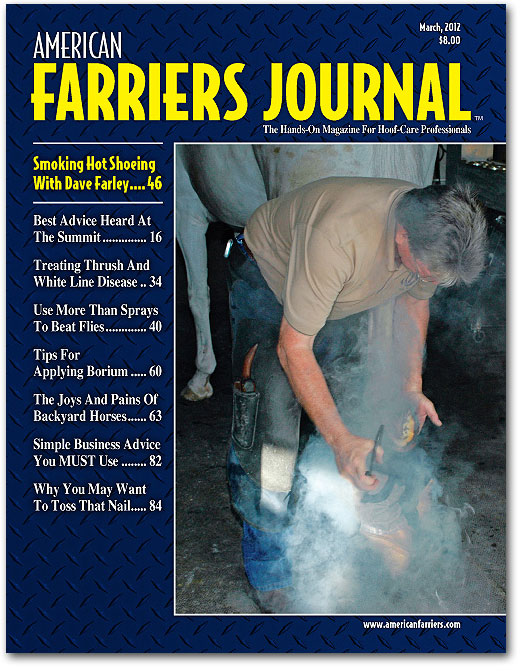
   Bob Smith of Pacific Coast Horseshoeing School was kind enough to review Millwater's Farriery: The Illustrated Dictionary of Horseshoeing and Hoofcare for the recent issue of the American Farriers Journal.


   The blurb from the review is "An excellent reference for shoers, owners and farrier students..."

   He also observed that the dictionary had evolved into a "mini-textbook" of farriery.  Something I realized myself as I was putting it together. 

   This actually gave me pause at the time...  After all, we are blessed with some really great, full-on farrier textbooks in this day and age.  It was certainly beyond the intended scope of the lexicon project to 'compete' with them.

   But the massive textbooks from Butler and Gregory are designed for dedicated students going through training at the better farrier schools on the way to careers as professional farriers, and retail for several times the list price of my book...  I know a lot of people interested in farriery aren't starting-out at that level.  Especially in times like these, I figured there was a place for an entry-level primer rooted in the fundamentals.  Something to get the prospective hoofcare provider (or horseowner who has to resort to doing their own) started so they can find out if it's really for them, then they can move-on to the more advanced training and texts appropriate to their chosen career paths.

   Smith did bust my chops on the "selected resources" appendix of the book...  And not without justification.

   I included Crudoir on the "periodicals" page.  At the time the review was written, all there was of the magazine was a webpage announcing the upcoming launch...  Since then, that has been replaced with an announcement that they've given-up on the plan for a new magazine as-such, and are going "another direction".

   Well, that's the peril of reference book publication.  Even in this modern age of fast publishing tech (and believe me, it's like greased lightning compared to the 'good old days'), I still had to put the content to bed and shift to formatting and set-up long before the actual release.  I'd been in-touch with the intended publisher of Crudoir, and she was in-earnest about making the magazine a reality...  I didn't have the option of waiting to see if it caught-on, so I included it.  Actually, I figured that even if it didn't fly, it'd be an interesting footnote in the future.  Henry Heymering's bibliographic history tome On The Horse's Foot cites a number of publications that are only known due to their being mentioned in old reference books.

   Then there was the fact that, with the folding of so many other farrier periodicals, the American Farrier's Journal is effectively the Last Man Standing.  Frankly, I had to stretch a little bit just to keep AFJ from being completely alone on the page! 

   As to the weakness of the "Internet resources" page, he's got a point there.  In truth, that section is almost vestigial.  Left-over from earlier dictionaries before Google was built right into all our browsers, when you actually needed to know a URL to get to a resource.

   I certainly didn't intend to snub the AFJ website in this section.  Since a URL was included on the "periodicals" section, where AFJ was at the top of a far less crowded page, I figured putting it in the "Internet" section was kind of redundant. 

   With the ever shifting sands of the Internet, I'm also a little reluctant to reference new Internet documents, as they have a nasty tendency to get moved or gone as websites get 'updated' and redesigned.  My personal favorites/bookmarks lists attest to this with tons of now '404' links.


   On a side-note, I included contact information with the Press Release which was really intended in-case the folks at AFJ needed to touch base with me.  (Sort of traditional PR format.)  Unfortunately, I apparently didn't make that clear, as my farm land line and snail mail address got published with the review...  I rarely use the land-line, and can barely hear incoming messages due to interference from the electric fences...  And all orders are ultimately processed over the Internet anyway.  (I do not have a warehouse of books and mail packaging like the not-so-good old days.)

   If someone really hates to order over the Internet, they can ask at a brick and mortar book store.  They're not likely to have Millwater's Farriery in stock (as it's a specialty kind of book), but it is available through regular distribution channels, so they can order it.


- 30 -

.