Thursday, March 26, 2015

Prophet's Thumb Farm: Appreciating Our Girls...


   Okay, before I snap and Go Henry VIII, doling-out executions for failure to produce a male heir, I should review some of the things I really appreciate about my broodmares and their {cringe} fillies...

Woe is me!  Afflicted with creatures such as these!

   Anne and I have been involved in horse breeding, sometimes on a much larger scale, for a very long time.  So, even without the many sad stories posted on the FB groups, we're well aware of the hyper-stressful horror show foaling season can become...  Knock on wood, the Belgians have been free of most of that.

   First, they've been foaling at 340-something days.  No "Oh no! It may be premature!" or "Ye gads, is this mare EVER going to foal?" stuff.   

   Second, they've been having trouble-free, unassisted births. (Except for Ethel popping Kirby out directly into the electric fence!)  Take it from someone who's had to reposition and pull all sorts of problem children into the world, finding a still-wet foal already out and either standing or about to stand is THE way to go!

   Third, the Belgians basically do it by the book...  Considerable wax in the morning, easily expressed, opaque, sticky milk that evening, foal the middle of that night.  None of that dripping milk, waxing, then holding it for another week to mess with my mind.  Also, no popping-out foals in the middle of the day half a mile across the big pasture. 

   Fourth, the robustly healthy, teat-seeking missile foals.  If you've ever had to deal with a baby who insists on trying to nurse on everything but the udder, or worse yet, a foal who doesn't want to suckle at all, you know how great it is to see a foal go straight to the target and heartily tank-up less than an hour after birth.


   Fifth, these big Belgians are instinctively good mommas.  Even with their first foals, the switch seems to get thrown and they seem like veteran broodmares about ten minutes into the job.  Having had to deal with mares that required physical restraint and sedation for hours before they'd let the foal nurse, and others who seemed unaware the foal was even there, and even the ones who mean well but are too hyper to let the foal find the spigot, I've gotta love our girls.


Rookie mare, first morning on the job last year.

   Last, but not least, I appreciate how beautifully our girls come through pregnancy, foaling, and nursing.  They are truly Industrial Strength mares...  The Quargian foals are big and hungry enough to put a strain on any normal mommas.  But the Belgians carry and birth 180# foals, nurse them 'til they're huge weanlings, all without showing a hint of ribs or hip bone.  And all on less feed than it would take to keep a Thoroughbred mare in tolerable shape.


That's actually a pretty big foal until you put it next to Lucy.


.

- - -

- 30 -

.


Monday, March 16, 2015

Prophet's Thumb Farm: On Draft Cross Sporthorses.


   European warmbloods have become the darlings of many American horse-folk in recent decades.  And for good reason.  Check out the various flavors of warmblood competing at top international events.  These are indeed impressive animals, worthy of a bit of envy.


   Problem is that there aren't that many of them, and they're way over yonder in the Old Countries.  So your chances of swinging by the local auction and picking one up are pretty slim.

   Yes, there are some European warmbloods in America.  But rather few of them resemble the horses we see on the international scene.  After all, the various European state breeding programs don't have a lot of incentive to sell their highest quality animals to Americans.  International horse-traders, like their domestic counterparts, want to get horses as cheaply as possible, then sell them at as great a mark-up as they can.  With so many Americans crazy for anything that can be called a Hanoverian, Trakehner, etc., they know that the European programs' lowliest culls will bring big money back in the colonies. 

   But not all Americans are willing to spend a fortune on what looks like an over-sized track washout thoroughbred just because it (or maybe one of its parents or grandparents) has a tenuous claim on being the product of a European breeding program.  It has occurred to many of them that, in America, we have a wide array of quality hotblooded horses and draft coldbloods.  Surely we could cross them and get our own American warmbloods!

   Well, if you want to see a European warmblood owner have a conniption fit, let them hear you call an American draft-cross a "warmblood".

   You can't really blame them.  Draft-cross horses have become more common in recent years thanks to the horse market absorbing so much PMU "rescue" stock.  (Feel free to tell me the story of how a PMU refugee you know went on to become a great horse for someone.  I believe you!  But that's an exception, not the rule.  When an animal's greatest value was the ability to produce urine, you can't expect a whole lot.)  These PMU and other low-grade draft horses weren't likely to get bred to any sort of quality light horse stock.  So now we've got plenty of draft plugs crossed with Joe-Bob's  "rackin' hoss" floating around on the horse market.  And, naturally, some folks try to get a few dollars more for them by calling them "warmbloods"...  Which is about like painting an '85 Chevette red and calling it a "muscle car".


Really not the best place to find great Eventers.


   But we do have quality, refined draft horses in America.  And awesome performance-type light horses.  Crossing the two can indeed produce sport horses that are closer to the international competition level warmbloods than many of the European breed horses available on the American market.

   European warmblood enthusiasts in America will quickly assert that the Hanoverian (or whichever flavor they prefer) wasn't made by crossing a hotbloods with drafts.  It was the result of many generations of breeding to achieve and refine a desired type.

   Of course, the modern American sport horse breeder isn't likely to start out by crossing Arabians fresh from the desert with ice-cold Brabants.  American horse stock is already the result of many generations of crossing and refining for type.  You could pretty much consider our performance light horse breeds (Quarter Horses, old school Morgans, Thoroughbreds, etc.) to be "hottish warmbloods", while our better, show-grade draft horses are essentially "cooler warmbloods"...  Selective crossing of the two is refinement, not starting from scratch.

   American breeders just need to remember that sport horse breeding is aiming for a specific target, not just mixing in a bit of draft blood... 

   To do it right, we need to give careful consideration to the breeding stock we cross.

   Drafts are used primarily to to add stature.  So there's no point in breeding to little draft horses!  You'll just be adding coarseness and subtracting grace from your foals.  Fortunately, the taller, high-quality (fancy carriage type) draft horses tend to be more energetic and elegant movers than the shorter, plow-type draft horses.  This will help prevent the foals from being overly thick, dull, and plodding.

   The light horses are used to add athleticism, endurance, and grace.  So a performance type horse is called-for.  Not show-hog halter horses, trick-gaited stock, any of the "Saddlebred-ized" bastardizations of historically fine breeds. (Yeah, I'm looking at you Arabians, Morgans!)

   Colors and patterns are a big thing in many American markets lately.  But you'll note that the European warmbloods tend to be solids.  I rather admire that they rely on quality of horseflesh and performance to distinguish their horses rather than fancy paint jobs.  (A Mercedes-Benz doesn't need flame decals.)  Still, its a matter of preference. I wouldn't say that spots and chrome disqualify a specimen from being considered a fine sport horse.


   Direction of the cross...

   Since any breeding program needs more mares than studs, and good light horses are far more plentiful than quality draft horses these days, the inclination may be to breed draft stallions to performance broodmares.  But doing it the other way around gives the foals the considerable advantage of gestating in the draft mare's industrial grade womb.  Normally (and fortunately!) a mare won't grow a foal too large for her to give birth to, regardless of the baby's genetic potential.  This means that a crossbred foal from a light mare is likely to be considerably smaller than one from a draft mare at birth, which runs contrary to the whole point of draft cross breeding.


The future...

   One of the most common posts on draft cross sport horse themed Internet forums is someone lamenting that thoroughbred and warmblood riders don't show them respect...  And everyone is too polite to point out the irony when the next most common posts are about draft cross owners doing DNA testing to try and get a vague inkling of their horse's heritage, or someone lumbering through a pony jump course on a plow horse.


Just because an animal can do something doesn't mean it will be competitive at it!


   It will always be hard to get the horse world to take draft cross sport horses seriously while "pedigreed crosses carefully selected to achieve the warmblood sport horse type" are lumped-together with "random grade horses who look like they might have some draft in them".

   Which isn't to say part-draft grades can't be good mounts at their own levels.  But it's just not the same thing as a purpose-bred draft cross sport horse.


.

- - -

- 30 -

.


Monday, March 9, 2015

Prophet's Thumb Farm: On Horse Rescue...


   In recent years, there has been a push to discourage folks from buying pets from breeders and dealers.  With millions of stray or discarded dogs and cats being put to death in pounds every year, it seems wrong to encourage breeders to produce more rather than giving homes to the ones already here and in dire need.


   Some people try to extend that line of thought to horses.  Why breed more horses when there are so many already being abandoned, going to slaughter, etc.?

   But horses aren't dogs or cats...


   Give a typical dog the run of a suburban back yard, a spot at the foot of the bed, a collar, leash, tennis ball, the odd bowl of kibble, and he's a happy camper.  The cat is cool with an apartment, sand box, and some Friskies.

   They keep us company.  Entertain us a bit.  Alert us to anything out of the ordinary.  Assist with our diets by eating a share of our cookies for us.  Maybe dispatch the occasional rodent.

   Most of us have no need for a specific breed/type of dog or cat.  When I needed a new farm dog, I had a general idea of what we wanted... Age, size, gender, personality.  Went to the pound and found what I was looking for.


Chompy!


   So I agree...  Outside of folks who need specially-bred dogs for specific work or hunting uses, it makes little sense to breed dogs or cats when the pounds are full of perfectly suitable candidates.


    Horses are so much more demanding...  They require acres of turn-out with miles of fences to maintain.  Stables that have to be cleaned.  Tons of oats and truckloads of hay.  Expensive tack.  Competent training and daily care.  Farrier service.  Worming.  Etc., etc., etc...

   In return, we justifiably expect more from them...  We ride them.  We drive them.  Miles and miles down country roads, mountain trails, and sandy beaches.  Maybe we use them in show or athletic competitions.  It can become a way of life.  An awesome way of life!

   But, contrary to what you may have seen in Hollywood movies over the years, you can't just grab any horse out of the kill pens at the dark end of the sale barn and make it into a Wonder Horse with a little TLC.  Sad fact is, most of them are there for a reason.

   The old, sick, lame, untrained, poorly bred rescue horse is going to require more investment of time, treasure, and resources than a healthy, sound, broke horse in his prime...  And is still likely to be a pasture ornament, companion, or limited use mount at best.  It's hard to maintain enthusiasm for pouring ever-increasing investment into an animal for ever-decreasing return, year after year after year.  Especially in the face of the various hardships and tough changes that may be encountered in the rescuer's life along the way.  Rescued horses often wind up needing to be rescued again.


   Overall, the horse world is better-off if people select the horses they need, rather than the horses that need them.  Horses that encourage their owners to actively use and enjoy them,  inviting owners to get more involved in the equestrian world.  To share them with friends and family.  Creating more horse people and more homes for horses in the process!


   Another way horses differ from dogs is lifespan.  Horses live twice as long as dogs.  While the typical dog owner's requirements are fairly constant over the years, active equestrians have evolving needs when it comes to horses.  So the whole "Furever Home" thing isn't really applicable to horses.

   The perfect horse for an eleven year-old beginner will be holding her back when she's a teenager with countless lessons and hours in the saddle to her credit.  She really ought to pass him down to a new beginner while she moves-up to a horse she can ride to the next level...  That way the beginner's horse gets a new home, the new girl gets a perfect beginner's horse, and teenager stays in the game, and the advanced horse gets a home too!  Developing riders are supposed to "outgrow" their beginner horses and move up. This is NOT a bad thing!

   So someone does need to be producing next-level horses above and beyond what can be salvaged from the dark end of the sale barn.

   Am I saying that no one should rescue horses from the kill pens?  Certainly not!  But we have to face the fact that we can't rescue them all.  There are only so many homes for horses to go to.  Only so many people to take them on.  And burning those people out with high-upkeep, low-use animals does nothing to promote horse ownership and create more homes for horses tomorrow.

   I think we need to think more in terms of Rehab than Rescue...  While the emotional inclination is to save the most hopeless and pathetic horses, the greater good would be achieved by saving the ones who have the best chance of becoming fully useful mounts, especially for new horseowners.

   This used to be the stock-and-trade of horsetraders.  Outbid the killers on horses that were a few months' TLC away from being sold for decent money.  One thing they used to say was "Never buy a horse based on sympathy."  There are things you can't reasonably expect to fix.

   Old age...  A healthy twenty year-old might have a lot of use and life left in him.  But a poor horse over sixteen is likely to require a lot more time and care to get back into flesh than a younger animal.  He's also likely to need more dental care.  And, if he's not already well-trained, it's pretty late in the game to be green.

   Crippled...  I've known a lot of supposedly crippled "navicular" cases that came sound with proper shoeing and nutrition.  But horses with limb deformities, chronic laminitis, popped knees, and assorted other maladies may only be kept tolerably sound with drugs and perpetual therapeutic farriery.

   Size...  Nope. That 13-2 three year-old is NOT going to make 16+ hands.  I don't care if your cousin's room-mate's sister-in-law says her horse grew a foot after four, it ain't happening!

   Breeding...  Poor conformation, half-gaits, and other congenital weaknesses.

   Yes, you may be able to salvage a geriatric, unbroke, lame pony with a crooked spine and inclination to pace...  Expending time and resources that could have made three or four better candidates home-worthy in the process!

   But you don't have room for three or four more horses?  That's the great thing.  Good candidates, after rehabilitation, may be great entry-level horses, ready to go to new homes!  The horse world needs more good beginners' horses, and the kill pens are a good source for them...  But rehabilitating  rescue horses really isn't a good job for a newbie.  With the horsetraders of old in short supply, we need more established equestrians to create a return path from the kill pens to the beginners.


Some of these horses may have the potential to fill an essential role in the horse world.
We just have to figure out which ones, and give them the chance.


.

- - - 

-30- 


Tuesday, February 17, 2015

Prophet's Thumb Farm: YMMV!


Your Mileage May Vary.

A blanket disclaimer...


   There's a common problem in modern discourse.  Perhaps more common on the Internet.

   When someone expresses a general observation or opinion, some folks hear it as an unqualified statement of an absolute nature applying to every individual case.

   For instance, if I for some reason mention that Mississippi is ranked at or near the bottom in terms of education, some people will think I said "Every single person in or from Mississippi is an illiterate moron!"  And they'll infer that I'm denying that their favorite cousin from Tupelo is the brilliant fellow they believe him to be.


   When it comes to horses, there are very few absolutes.  And there are usually marked exceptions to what few rules there are.

   Some years (okay... decades) ago, I found myself involved with Paso Fino horses.  And I've still got the scars and limp to show for it!  The breeders call it "brio".  Everyone else calls it "psychotic mania".  When farriers got-together, we'd play with the rookies by threatening to spread the word that they were Paso Fino specialists.

   And the very best-mannered horse I ever worked on was a Paso Fino stallion.  Belonged to a little girl out in the boonies who rode him everywhere.  And he gaited quite well, fino and all.  In all the years I shod him, he never so much as hinted at wanting a foot back before I was done with it.  She could drop his rope and trust him to stay put, even with other horses in close proximity.

   So don't take anything I write as a personal attack against you or your horse. 

   If I write that, after seven years of age or so, maiden mares tend to become increasingly difficult to settle with their first foals, there is no need for you to CAP-scream at me that you know maidens who settled just fine at twenty.  I believe you!  Same goes for your "kill-pen to blue ribbons" and "formerly lame, now sound barefoot over rocks" horse stories.

   But a relative few successes don't negate the overall trends and probabilities. 


.

- - -

-30-


Friday, December 19, 2014

Millwater's FARRIERY: Horseshoe Repair for Horseowners.


   Hope you're all having a very merry Christmas season!

   Over the years, I've heard from many horseowners that their access to truly competent horseshoeing is limited because the quality farriers are too far away and don't want to make the trip for small barns.

   What people may not comprehend is that pro farriers build their practices on providing reliable service to their customers, and that goes beyond just the scheduled shoeing days.  No matter how well a horse is shod, there will occasionally be a loose or thrown shoe.  (In fact, shoeing approaches that sacrifice proper support and protection to make the shoes harder to lose are a major source of the "evils of horseshoes" concept.)  So the farrier isn't just thinking about whether he should drive out to you place to shoe your horses, but also whether he'll be able to get out in a timely manner to do patchwork.

   One thing that makes it easier for a farrier to say "yes" to a remote client is the knowledge that he won't be asked to warp his schedule out of shape to come tack one shoe back on.  Horseowners capable of doing their own patchwork are not only attractive clients for dedicated farriers, but also can travel with their horses knowing that they won't have to rely on some stranger if their horse manages to hang a shoe away from home.

   And patching a shoe doesn't require a professional farrier's rolling shop.  A simple, inexpensive kit is sufficient...


   Nor does the task require the skills of a journeyman farrier.  With the hoof already trimmed and balanced, the shoe already fit, and the nail paths through the wall already established, flattening the iron and tacking it back on is well within the layman's capability.

   This sample from MILLWATER'S FARRIERY: The Illustrated Dictionary of Horseshoeing and Hoofcare is assembled from several of the book's encyclopedic entries, and gives an overview of how to fix that thrown, loose, or bent horseshoe for horseowners.

   Of course, the book is designed for cross-referencing, so you don't quite get the full effect here. And the illustrations are much higher resolution in print (downgraded to keep the online file smaller).

.PDF files at links.  


   Be forewarned though...  This is the kind of capability that can make one perhaps a little TOO popular around the stables or group trail ride.


- - -

-30-

.


Friday, November 28, 2014

Millwater's FARRIERY: 20 Years of the Farrier's Dictionary...

.

   Hope you all had a great Thanksgiving, and are progressing into a merry Christmas Season!

   2014 marks the 20th anniversary of Millwater Publishing's dictionary of farriery publications. It started with just a humble, saddle-stitched glossary with pen and ink diagrams and daisy-wheel generated master copies...


   Since then, there have been many updates, expansions, and upgrades in production.  Now it's a perfect-bound trade paperback or glossy hardcover with photographic illustrations. The content has evolved into more encyclopedic form, with extended articles and lots of cross-referencing for efficiency.  Covering ground from basic horsemanship to advanced farriery, with a focus on practical application. 

   It makes me a little embarrassed to look back at some of the early editions.  But they do serve as interesting markers to the eras in which each edition was published.


   The current edition is designed to be a handy reference for horseowners, students, farriers, and other equestrian professionals.  


   I usually post promotional discount codes for the hardcover version on the Millwater Publishing FaceBook Page and Twitter feed.  (I don't make those up.  I just report 'em!)  

   Right now, Amazon is doing 30% off the trade paperback if you use checkout code HOLIDAY30

   And, to celebrate 20 years of the lexicon project, I'm going to do them one better for Black Friday through Cyber Monday with 50% off the trade paperback when you ORDER DIRECT and use check-out code RXYKQG6P


.

---

-30-


Monday, March 24, 2014

Prophet's Thumb Farm: Why Quargians?


   I have always loved the classic, ranch/performance type American Quarter Horse.  About as close to the perfect balance of power, speed, agility, soundness, energy, sane disposition, and beauty that can be achieved in horse breeding.  Resulting in an animal of great versatility.  The best horse there is for a number of things, and pretty darned good at a great many more.


   But the classic Quarter Horse has a shortcoming, at least in the eyes of many in the horse world.  The best Quarter Horses have always been around 15 hands, give or take a couple inches.  There is frequently a demand for taller horses, for reasons both practical and not.  Too often have I known people to look at an excellent Quarter Horse and say "he'd be perfect, if only he were a hand taller!"

   So, naturally, breeders have been trying to produce extra-tall Quarter Horses for many years... Which gives us some problems.

   First, the very concept involves warping the Quarter Horse out of his traditional standard.  A Quarter Horse has no more business being 16+ hands tall than a fish has being covered with feathers or a cat has wearing antlers.

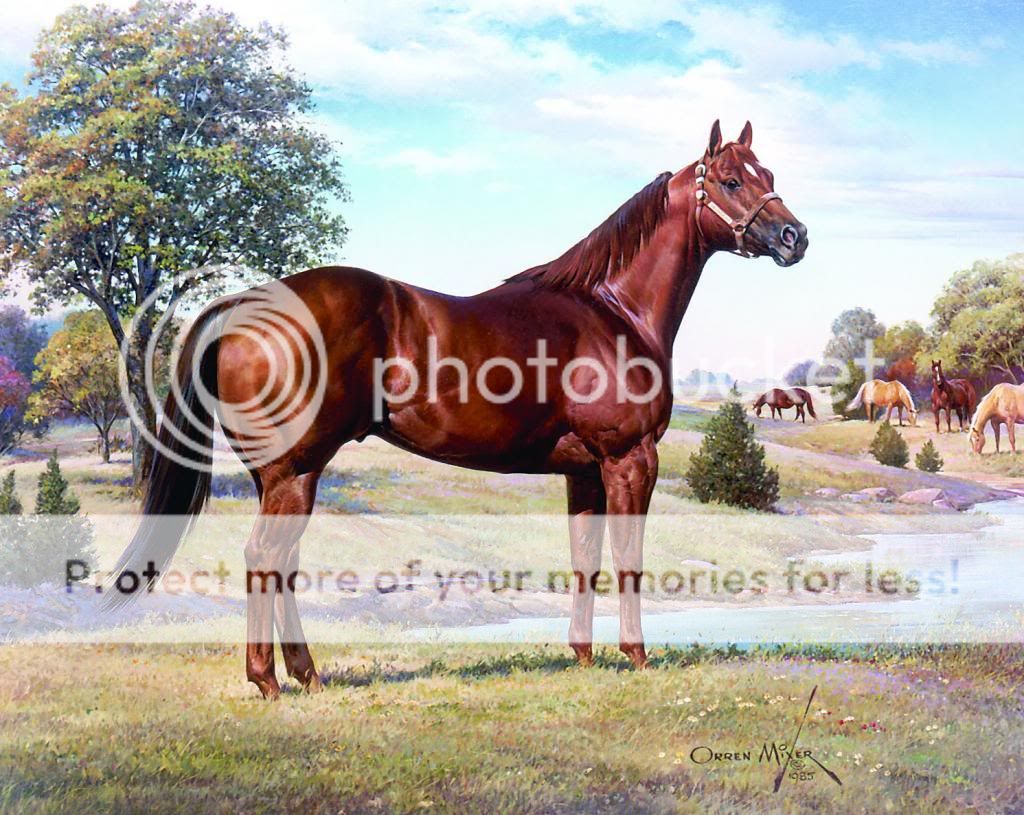
Quarterhorse?

    It's sad to see an over-sized "Quarter Horse" with all the agility of a school bus getting dusted at the barrel races by a Welsh/Arabian pony who is closer to the traditional Quarter Horse standard than his AQHA registered competition.

   Second, since selecting for height means neglecting other factors, the result is often far from the scaled-up Quarter Horse people wanted.  I've seen 17+ hand AQHA registered horses, and they usually look like they were assembled from leftover camel parts.


   Finally, breeding Quarter Horses for height often means out-breeding to Thoroughbreds.  The AQHA enables this (via Appendix registry) to allow TB athleticism and refinement into the American Quarter Horse breed.  But it also happens that TBs are on-average considerably taller than Quarter Horses, and there are quite a few really tall TBs around.  So much Appendix breeding is done just to get tall Quarter Horses...  Problem is that TBs aren't bred or known for long-term soundness.  They're race horses.  So the best ones have a career of only a few youthful years, with a professional crew of grooms, vets, and farriers holding them together by constant effort.  This is the polar opposite of the traditional Quarter Horse's expected decades of low-maintenance service.  Add to this a certain level of incompatibility between the Quarter Horse's powerful musculature and the TB's lightweight hooves, joints, tendons, and ligaments, and perhaps you begin to see the problem.

   I don't know if there have been any scientific studies to back this up, but as a farrier I observed that, for every inch of height above 15-2 in a Quarter Horse, there is an exponential increase in the probability of unsoundness.  I doubt it's a coincidence that the trend for 16+ hand AQHA horses in the '80s corresponded to the Quarter Horse, once renowned for soundness, becoming known as a breed for which support shoeing, isoxsuprine, bute, and neurectomy were considered almost normal!

   So, rather than distorting the great old Quarter Horse beyond recognition to produce unsound specimens with AQHA paperwork, we decided to go outside the AQHA system to satisfy the demand for something akin to a super-sized Quarter Horse.

   Starting with sound, highly athletic, well-bred Quarter Horse stallions, we looked for mares who could contribute the desired stature to the mix without introducing TB fragility...  And the best candidates we found were pedigreed, carriage-type Belgian draft mares.  They brought greater than TB height to the table, along with over-engineered hooves, joints, tendons, and ligaments. 

   The goal of this Quarter Horse - Belgian (Quargian) crossbreeding is to produce great American sport horses.  Essentially Quarter Horses scaled-up to warmblood size without the conformation and soundness drawbacks that plague so many big Appendix Quarter Horses.


And so it begins...


.

- 30 -

...